
SpaceTech 101: How Reusable Launch Changed the Space Economy
Rockets used to be fireworks — light once, watch, forget. Then a handful of very stubborn engineers taught them to come home. Here's the tech, the roster, and what it actually means for your portfolio.
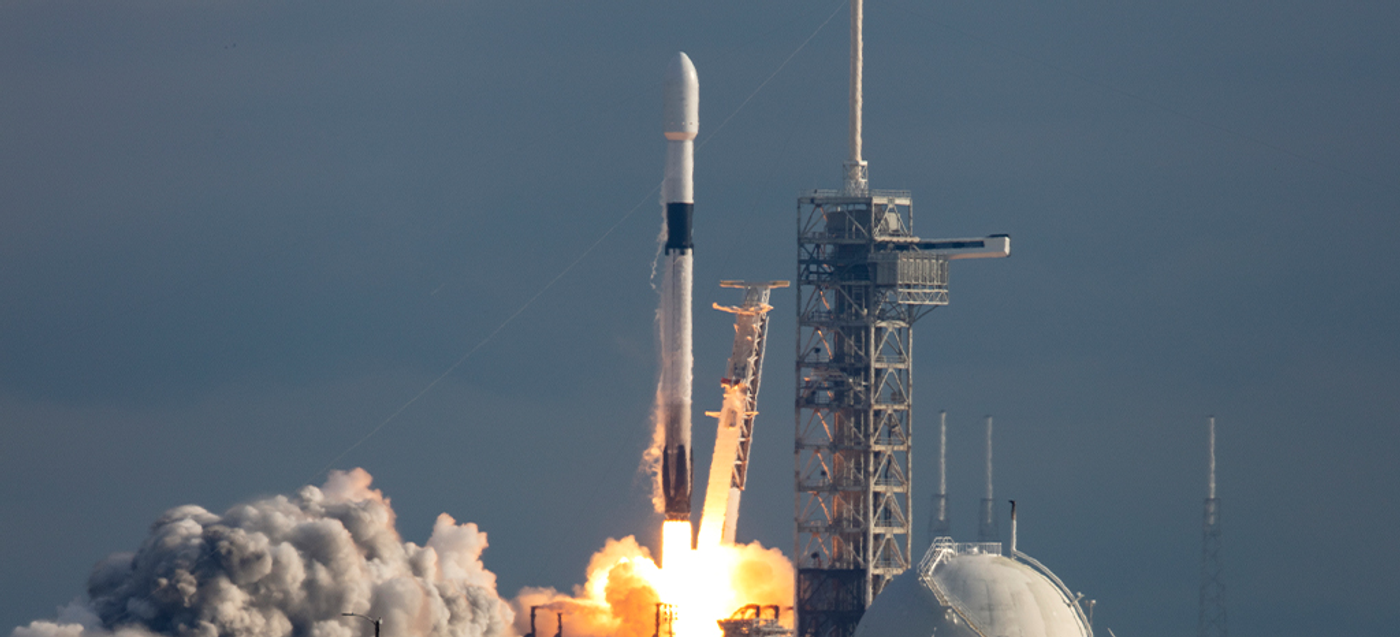
Here's a fact that sounds made up: for the first fifty-odd years of spaceflight, we built rockets like fireworks. Light it, watch it go, and never see the multi-million-pound engine again. Every single launch, we threw away turbopumps, guidance computers, entire fuel tanks — into the ocean, or straight into the atmosphere.
Then, starting around 2015, a small number of extremely stubborn engineers decided that was mad, and taught rockets to land themselves and fly again. That idea — reusable launch — might be the single biggest structural shift in the space industry since the Moon landing. It's also, depending who's pitching you, either basically solved, half-solved, or an elaborate trick performed by one company with unusually good aim.
What is reusable launch?
Start with the bit everyone half-knows: a rocket has at least two stages. The booster is the enormous first stage that does the brutal work of getting off the ground — the sprinter who runs the first flat-out 100 metres, then hands over. The upper stage is the second runner, already moving at a ridiculous speed, that carries the baton (your satellite) the rest of the way to orbit.
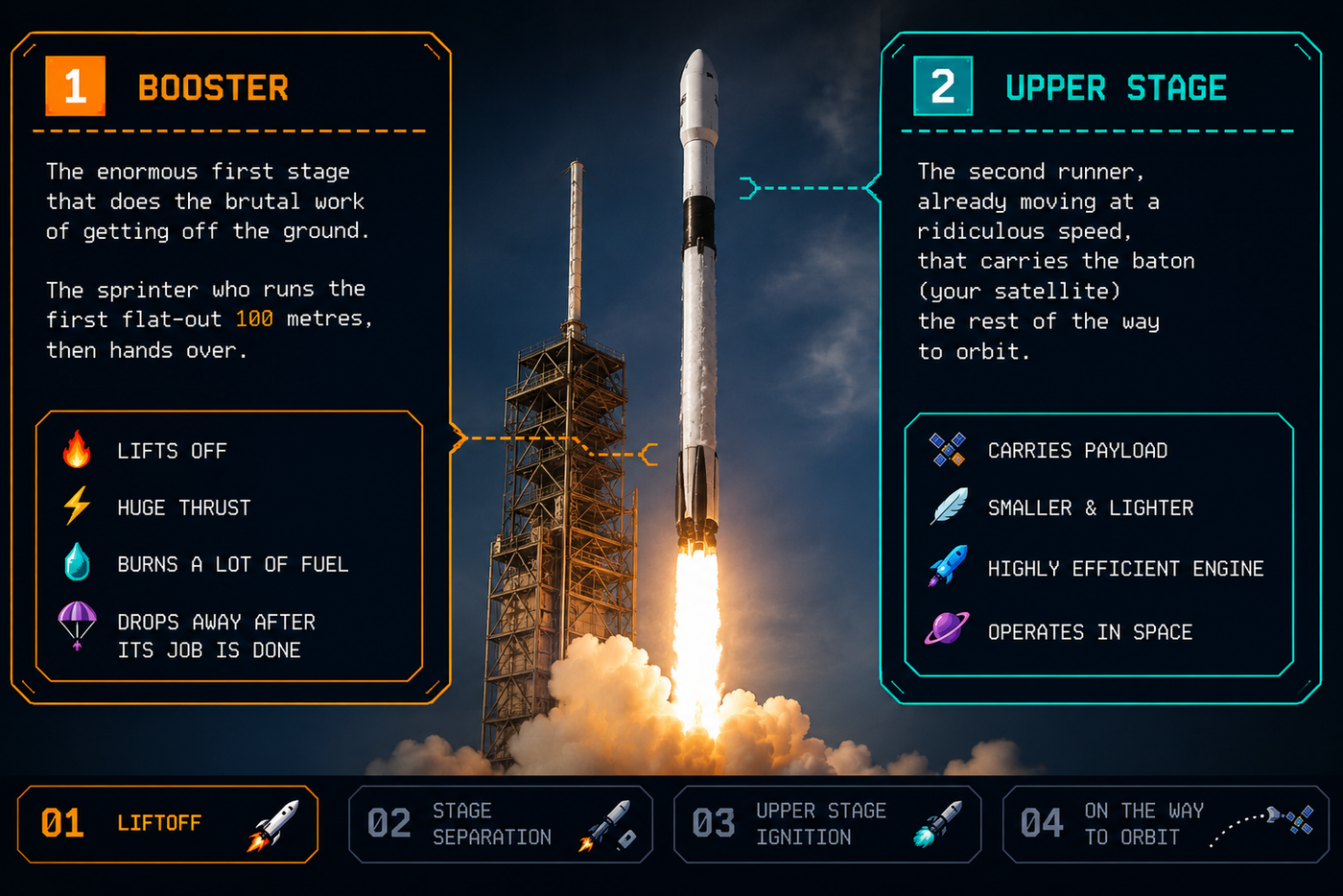
Reusing the booster captures around 70–80% of the value because it is usually the most expensive single part of the rocket. It is also easier to recover because it never travels as fast as the upper stage. The upper stage is much harder to reuse. It returns from orbital speed carrying roughly 25 times more energy to lose on the way down. That demands much tougher heat protection and a more complex re-entry system. Only a few companies are attempting it.
Most reusable rockets today therefore recover only the booster and discard the upper stage. SpaceX’s Falcon 9, Blue Origin’s New Glenn and several Chinese programmes follow this model. This is called partial reuse.
Full reuse means recovering both stages. As of today, precisely nobody has done that commercially.
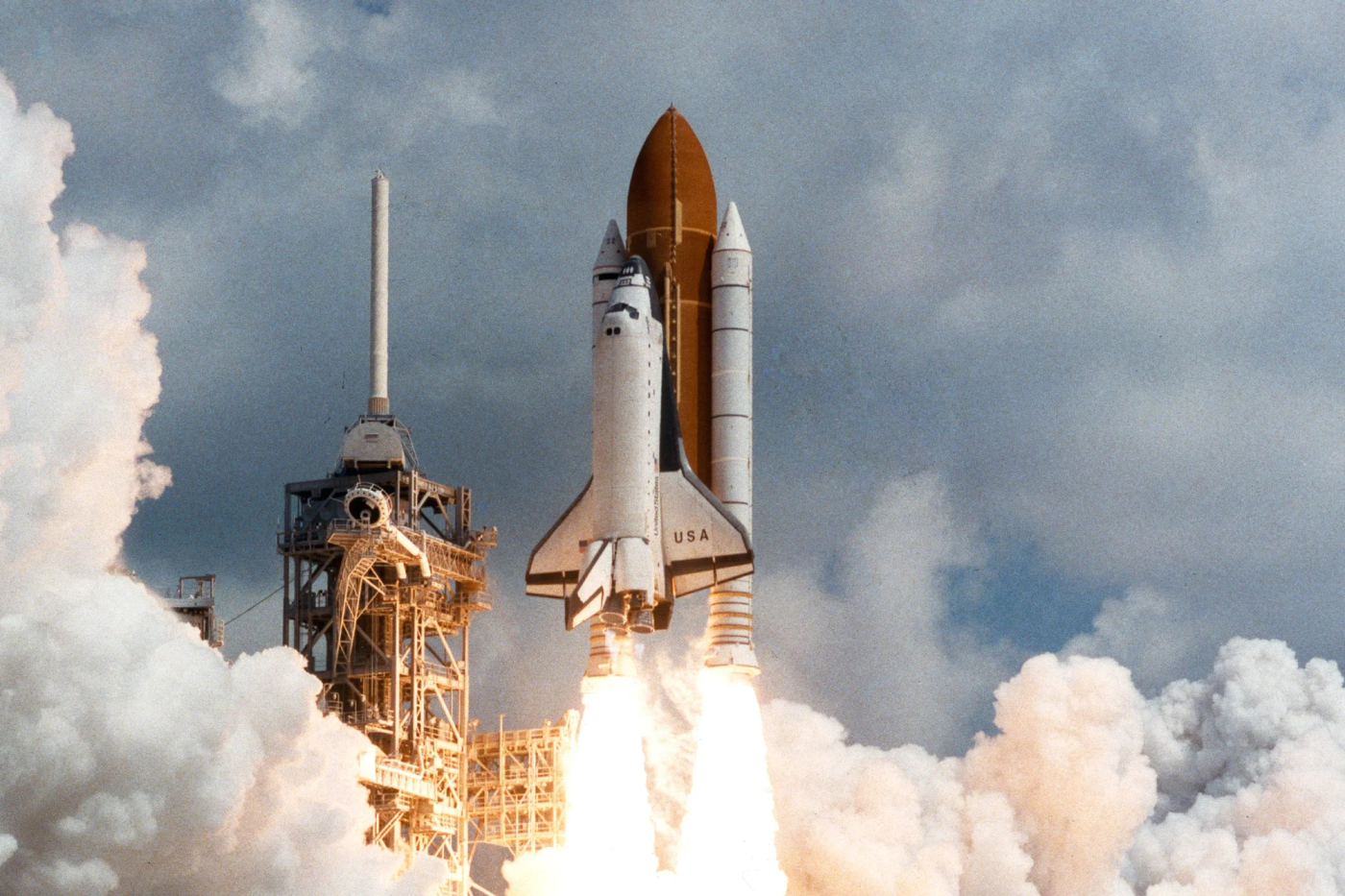
Most modern reusable boosters land vertically: engines pointing down, descending onto a pad and standing upright. This is the approach used by SpaceX, Blue Origin and several Chinese programmes. The alternative is a runway landing, like an aeroplane. The Space Shuttle used this method, but it is now much less common.
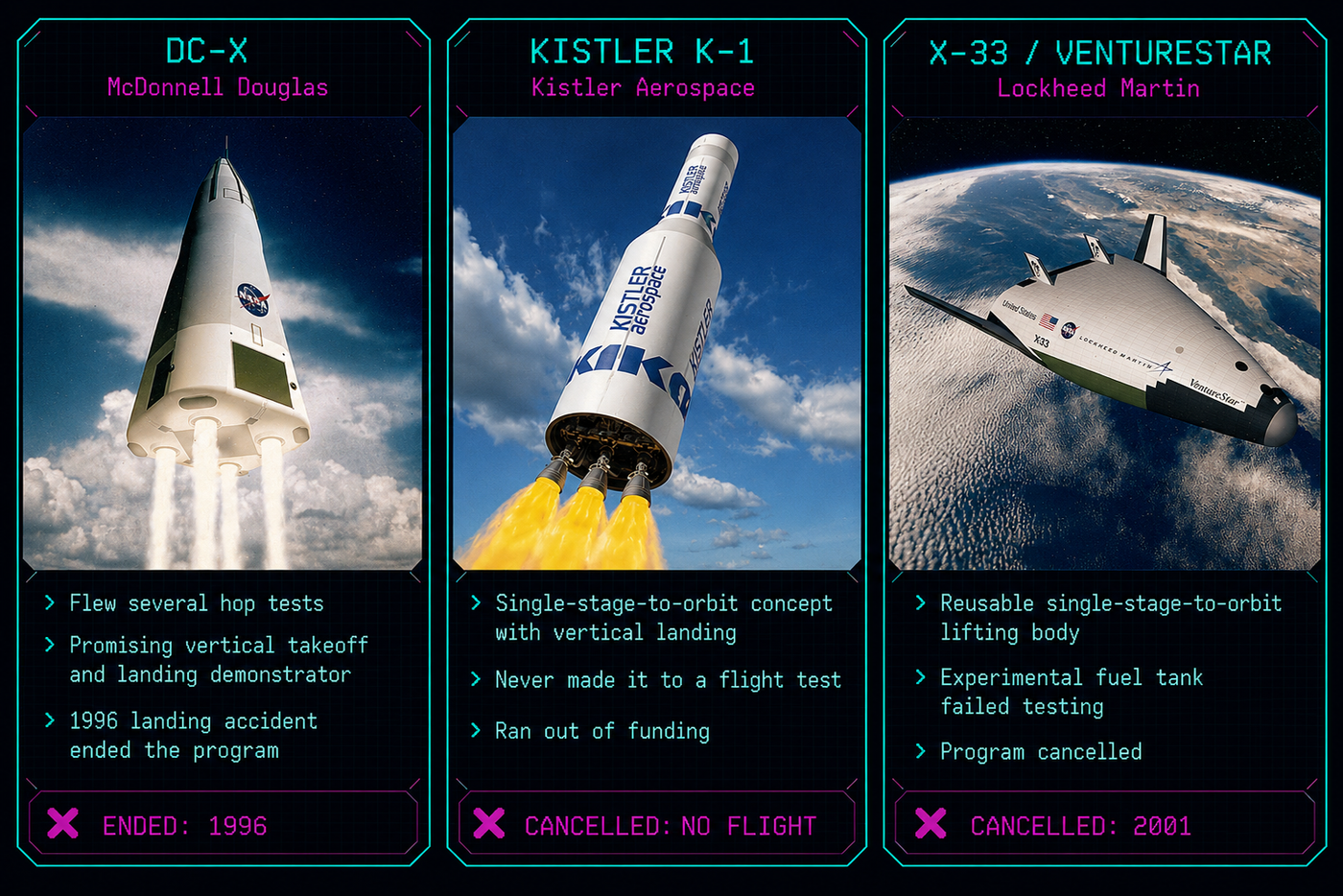
The 1990s and 2000s are littered with other reusable-rocket attempts that never made it past the test stand: DC-X, Kistler's K-1, and Lockheed's X-33/VentureStar space plane, cancelled after its experimental fuel tank failed. All of them chased the same idea SpaceX eventually cracked — a decade or two too early.
So next time someone pitches you a "reusable rocket," ignore the marketing and ask five boring questions instead: what does it actually cost per kilogram to orbit; how often does it fly; how quickly can the same booster fly again; how many times has one booster actually flown; and how much payload do you sacrifice to bring it home safely (recovering the booster instead of expending it typically costs somewhere around 30% of what the rocket could otherwise carry). Everything else is decoration.
Why this is the main character of spacetech
Why it matters
The economics are simple: reusing a rocket spreads a huge one-off manufacturing cost across many flights, so the price per launch collapses. A reused Falcon 9 reaches orbit for roughly $2,500–3,000 per kilogram, versus about $54,500 for the Space Shuttle — a discount of more than 95%, and a major reason launching thousands of satellites became economically possible.
Public launch price divided by maximum published LEO payload for the stated configuration. Nominal US dollars; lower is cheaper.
But companies often blur three very different numbers:
- the list price paid by customers;
- the internal cost of operating the mission;
- and the marginal cost of adding one more flight after the infrastructure has already been built.
SpaceX’s list price is public; its internal cost is likely lower; and the marginal cost of another Starlink mission is lower still. Claims of $100-per-kilogram launch usually refer to Starship’s hoped-for future marginal cost, not a price customers can access today. It is a projection, not an achieved fact.
Demand is also more circular than it first appears. Giant satellite constellations such as Starlink, Amazon Kuiper, China’s Guowang and Qianfan, and Europe’s IRIS² only make sense because launch became cheaper. But launch became cheaper largely because SpaceX needed enormous launch volume for Starlink. Cheap launch did not simply meet demand — it created its own biggest customer. In 2025, most Falcon 9 missions carried SpaceX’s own satellites rather than external payloads.
There is also a geopolitical motive
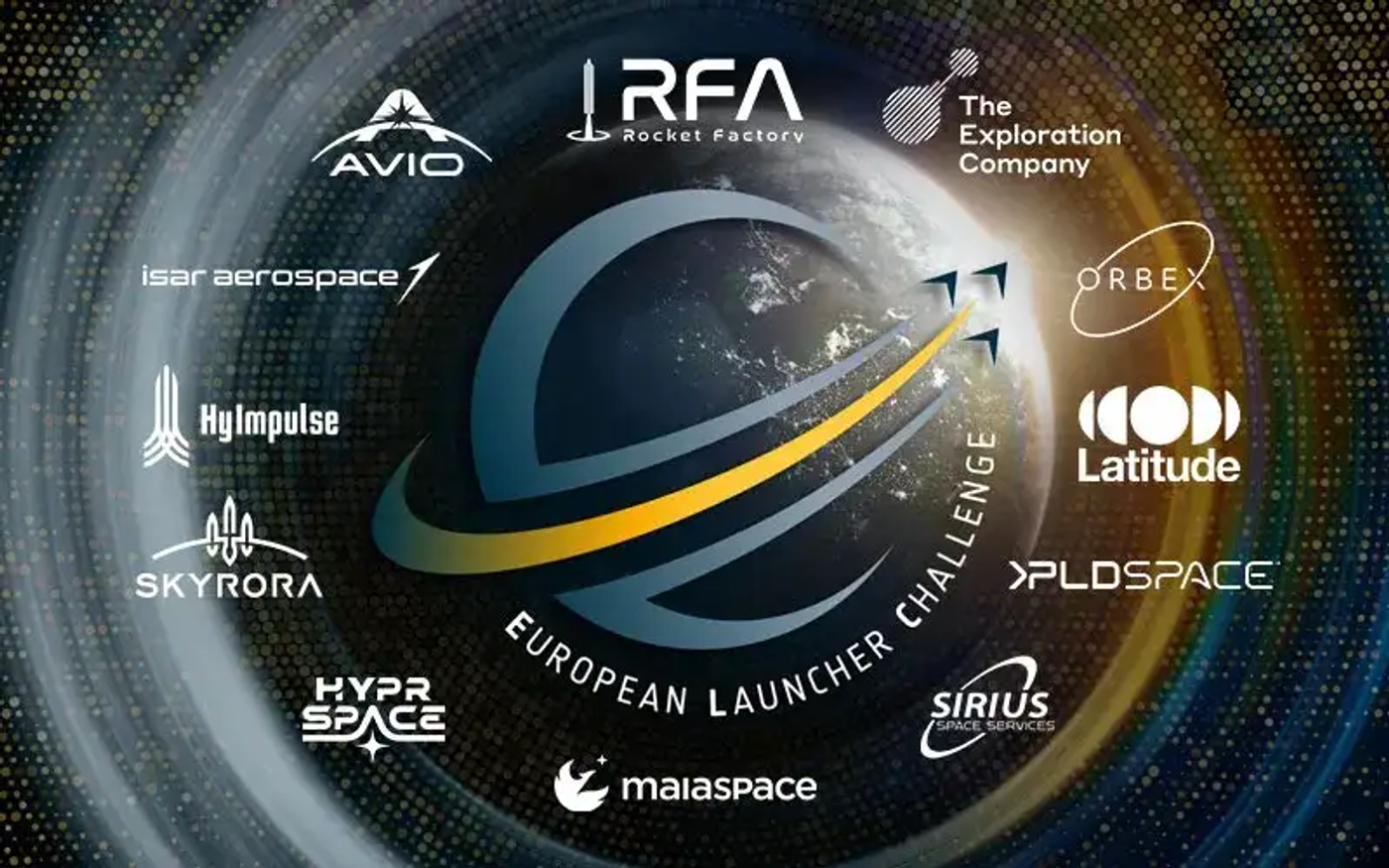
Europe, China and other regions want independent access to orbit even when the economics are weaker. Europe’s support for launch startups through programmes such as the European Launcher Challenge is therefore buying sovereignty, not necessarily the lowest price per kilogram.
Cheaper launch also changes what gets built. Engineers no longer need to optimise every gram so aggressively, making heavier, cheaper and more ambitious spacecraft possible — from in-orbit factories and satellite servicing to, eventually, data centres in space.
The catch is that reusability only works if the rocket flies often. Recovery requires extra fuel, hardware and upfront cost, while reducing payload capacity. A rocket flying only a few times a year may still be better off disposable. The winning formula is high flight frequency, deep vertical integration and a customer that needs a huge number of launches — ideally, your own satellite network.
Cheap launch did not just meet demand — it built its own biggest customer.
What's actually under the hood
Skip the engineering degree — here's what you actually need to know about the tech that gets a rocket home in one piece.
Fuel. Many new reusable rockets use methane and liquid oxygen, or “methalox,” instead of kerosene. Methane burns more cleanly, leaving less soot to remove before the next flight. It could also, in theory, be produced on Mars — one reason SpaceX chose it for Starship.
Landing. Gravity brings the rocket down; the hard part is stopping it on a car-park-sized target. Because the engine cannot hover gently, the booster performs one precisely timed final burn — the “hoverslam” — designed to reach zero speed at ground level. The guidance maths originated in NASA research on precision Mars landings, making the algorithm a genuine part of the breakthrough.
Materials. The industry still disagrees on what reusable rockets should be made from. SpaceX chose cheap, tough and easily welded stainless steel for Starship, an approach also used by China’s LandSpace. Rocket Lab chose lightweight carbon fibre for Neutron. Neither strategy has clearly won.
Heat shields. This is reusability’s final boss. An orbital stage returns with roughly 25 times more energy to shed than a booster coming back from a shorter flight. Nobody has yet built a heat shield that can land, receive a quick inspection and fly again the next day. Starship’s tiles still require redesign and replacement, which is a major reason full reuse remains unsolved.
Getting it home. A booster can land on a sea platform, return to the launch site or, in SpaceX’s case, be caught by giant tower arms known as “Mechazilla.” Rocket Lab tested helicopter catches before switching to the more sensible option: recovering boosters from the ocean.
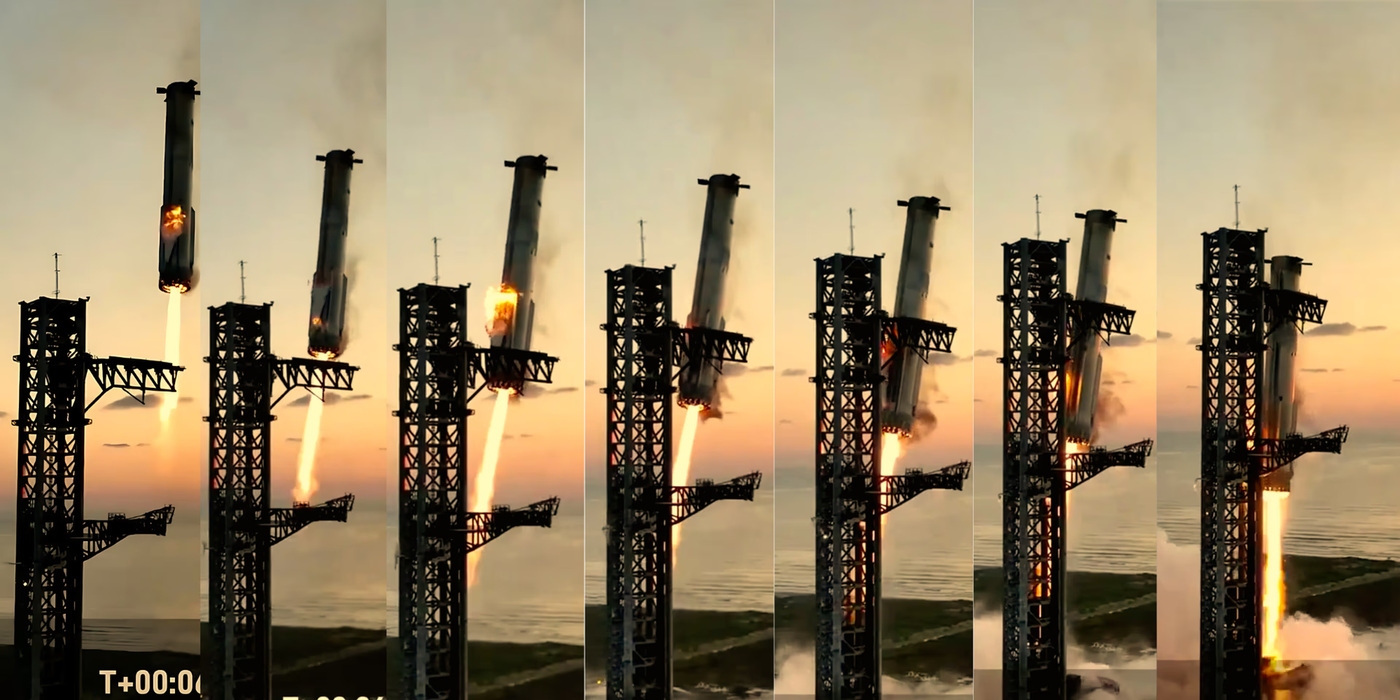
The less exciting truth is that landing may not be the biggest bottleneck. Manufacturing speed, launchpad turnaround and regulatory approval still determine how often a rocket can actually fly.
Who's actually playing
Player select. Loosely graded on where each one actually is, not where their press release says they are.
▣ United States
▣ Europe
▣ China
▣ India, Japan & the rest
Also flying: Sierra Space's Dream Chaser (an old-school reusable space-plane), plus smaller players like Phantom Space and Vaya Space.
Also in the mix: HyImpulse, Latitude, Sirius Space and The Exploration Company. Europe's response has been to hand up to roughly €169m each to five companies through the European Launcher Challenge — worth noting Orbex got far less than the others, and folded anyway.
Roughly where SpaceX was about a decade ago, but catching up fast — pushed by two enormous state satellite-fleet plans that need rockets faster than China can currently supply them.
What's ahead, next decade
A few honest predictions, and a few honest warnings.
Starship is still mid-development, not finished. It hasn't caught its own upper stage yet, hasn't refuelled itself in orbit yet (which NASA's Moon plans actually depend on), and keeps slipping its own timeline. Big if true. Not true yet.
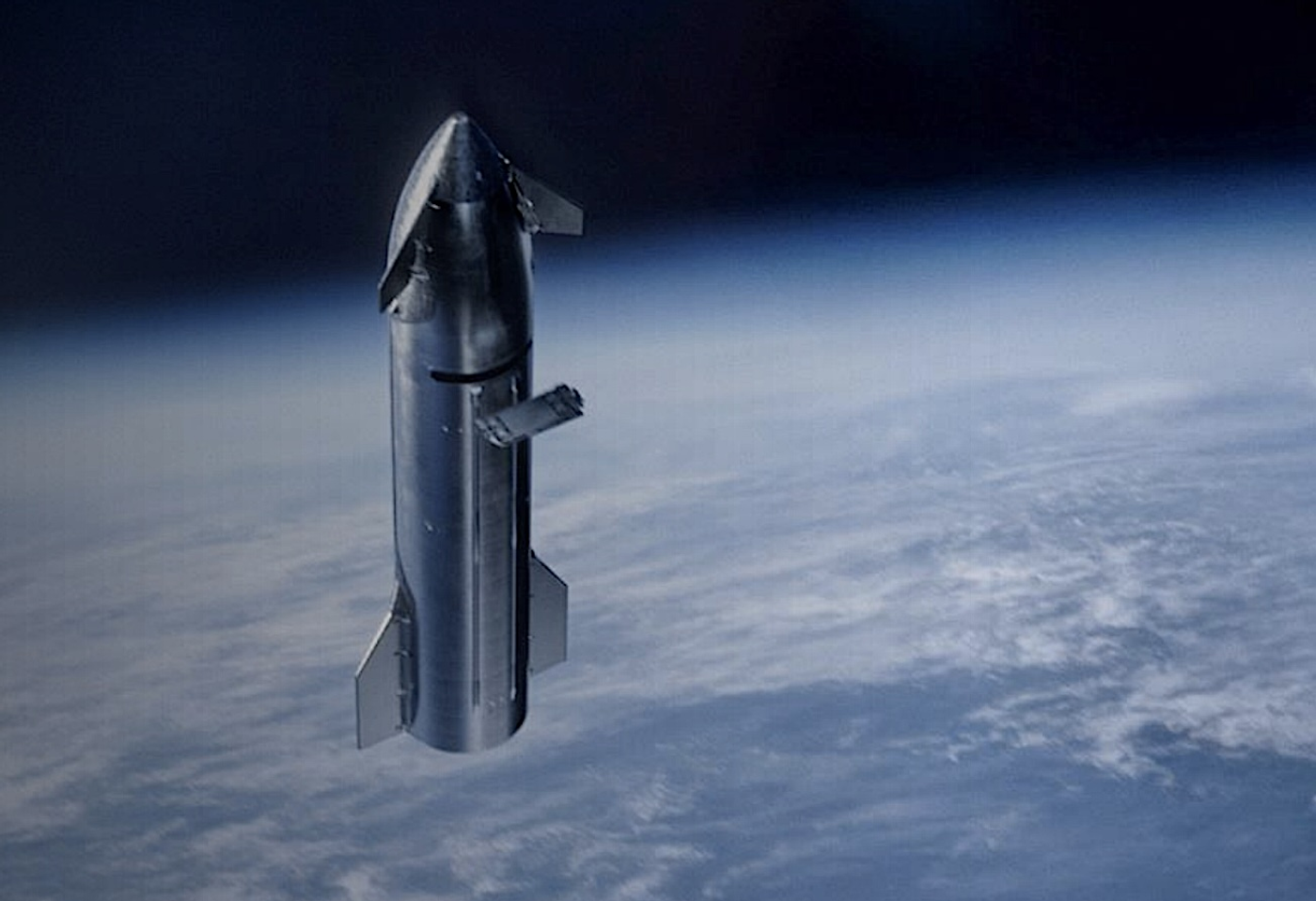
Full reuse — both stages, not just the booster — is the next real unlock, and whoever gets there first (most likely SpaceX or Stoke Space) changes the game again. Nobody's there yet.
Point-to-point rocket delivery — shipping military cargo anywhere on Earth within the hour — is a real, funded programme, and also, honestly, still mostly a very cool idea rather than an imminent service.
Expect launch volumes to rise and prices to keep falling, but probably not to the dramatic levels currently promised—at least not before 2030. The market will also consolidate: there are more small rocket companies than demand can support, so several will disappear.
Cheaper, more frequent launch will keep opening new markets, from satellite servicing and debris removal to in-orbit manufacturing and even proposed space-based data centres.
The constraints are less glamorous but real. Regulators limit launch frequency, orbital congestion is worsening, and scientists are still studying how hundreds of annual launches could affect the ozone layer.
This is also a strategic race. Whichever of the US or China masters reusable launch at scale gains a major advantage in deploying satellites, communications infrastructure and military surveillance. Reusable rockets are no longer just a business story; they are geopolitical infrastructure.
Venture takeaway
Launching rockets is a brutal business: capital-intensive, low-margin once operational, and increasingly just an input cost for whoever owns the satellites. SpaceX illustrates the point—launch grew modestly in 2025, while Starlink grew far faster. The rocket is not the business. It is the delivery van.
That makes it difficult to treat every launch company as an equally strong venture case. The more credible businesses tend to have built-in demand, such as their own satellite network or long-term government contracts, or a genuinely differentiated technical approach. Others risk entering a market where launch capacity becomes increasingly commoditised and where SpaceX already holds a major advantage.
The steadier money is in picks and shovels: Engines, heat-shield materials, guidance software, testing services, ground systems and specialist components can serve multiple programmes rather than depending on one rocket succeeding.
If a rocket company wants to go public before it's really flying and profitably, treat that as a warning sign, not good news.
The SPAC wave also shows what happens when market expectations run ahead of technical execution. Several space companies listed before proving reliable operations or sustainable economics, and their valuations later collapsed.
The timelines make launch a difficult fit for traditional venture capital. Building a reusable orbital rocket can take close to a decade and require hundreds of millions, or even more than a billion dollars. That development cycle is often better suited to governments, strategic investors and very patient capital than to a conventional fund expecting liquidity within ten years.
For the UK and Europe, competing directly with SpaceX on price remains especially difficult. The more defensible business models may sit around sovereign access, defence demand, satellites, in-orbit servicing, manufacturing and components used across multiple launch systems.