
Fusion 101: The Physics of Building a Star
This piece lays out the physics — why fusion produces energy at all, what conditions trigger it, and why sustaining those conditions has taken the better part of a century to get close to right.
Fusion has been "twenty years away" for about seventy years.
That joke gets repeated so often it's become a substitute for actually understanding why the problem is hard. It isn't hard because scientists have been lazy. It's hard because the conditions required sit at the extreme edge of what matter can physically tolerate.
This piece lays out the physics — why fusion produces energy at all, what conditions trigger it, and why sustaining those conditions has taken the better part of a century to get close to right.
Why fusion releases energy in the first place
Fusion works because of a quirk in how atomic nuclei store energy.
Every nucleus is made of protons and neutrons held together by the strong nuclear force. The tighter the binding, the lower the energy of the system — and the more energy gets released if you form that configuration from looser components.
Plot "binding energy per nucleon" against atomic mass and you get a curve that:
- rises steeply through the light elements
- peaks around iron
- falls gradually for the heavy elements
Light nuclei sit on the rising slope. That means two of them, fused into a single heavier nucleus, land at a more tightly bound configuration — and the difference in binding energy has to go somewhere. By Einstein's E=mc², it comes out as energy. This is the same physics that powers every star, including the one keeping Earth warm.
The fuel: deuterium and tritium
The reaction fusion research actually targets combines two heavier isotopes of hydrogen:
²H + ³H → ⁴He + n + 17.6 MeV
That's deuterium plus tritium yielding a helium nucleus, a neutron, and 17.6 million electronvolts of energy — roughly 10 million times more energy than burning a single molecule of methane.
The 17.6 MeV doesn't come out as one lump. It splits:
| Product | Energy | Behaviour |
|---|---|---|
| Helium nucleus (alpha particle) | 3.5 MeV | Charged — stays in the plasma |
| Neutron | 14.1 MeV | Neutral — flies straight out |
That split is fundamental to how a fusion power plant would actually work.
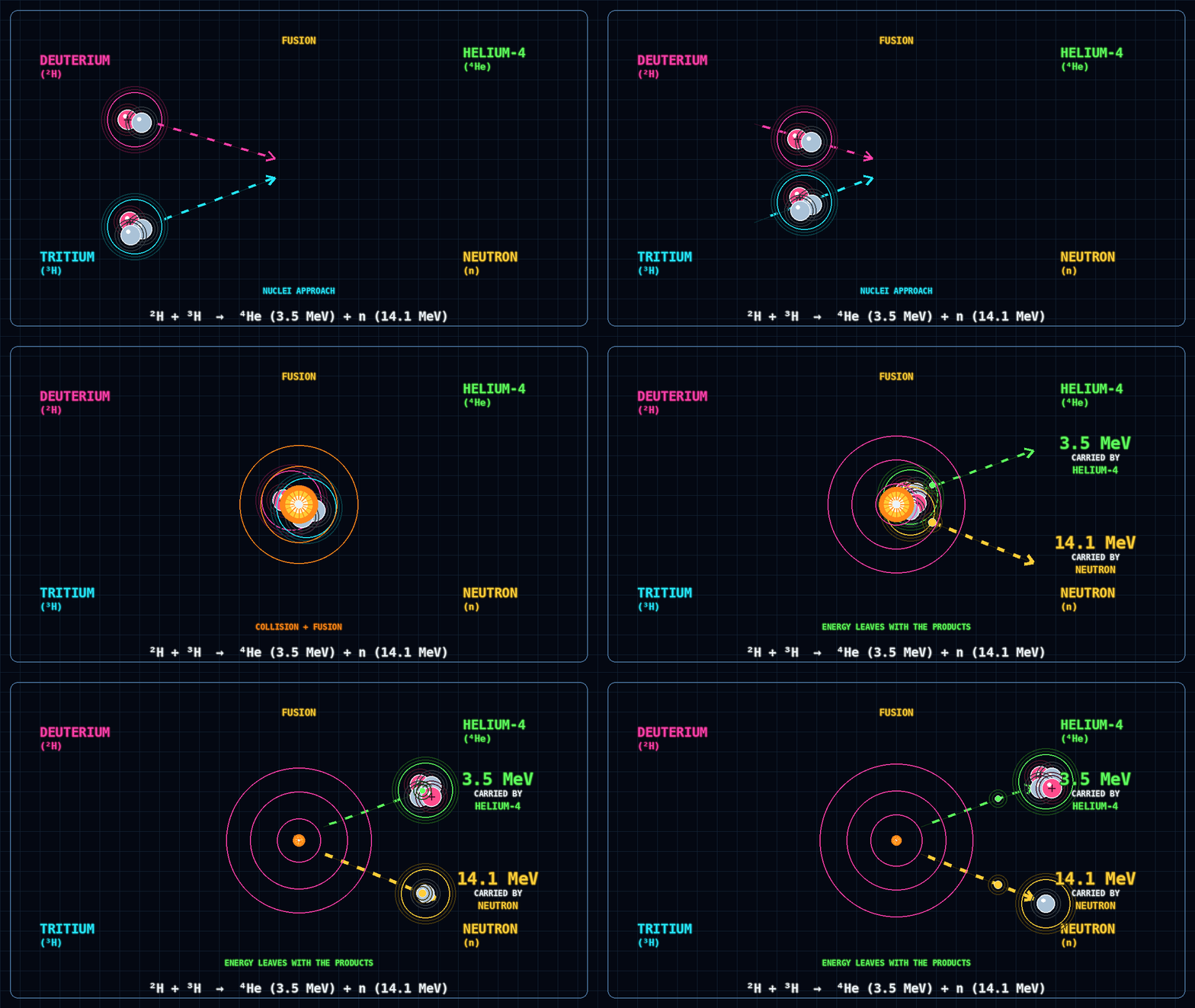
The alpha particle is positively charged, so magnetic fields can hold onto it. It re-collides with the surrounding plasma and deposits its energy back in — a process called alpha heating. Get enough of this going and the plasma starts sustaining its own temperature. That self-reinforcing state is called a burning plasma, and it's the precursor to ignition.
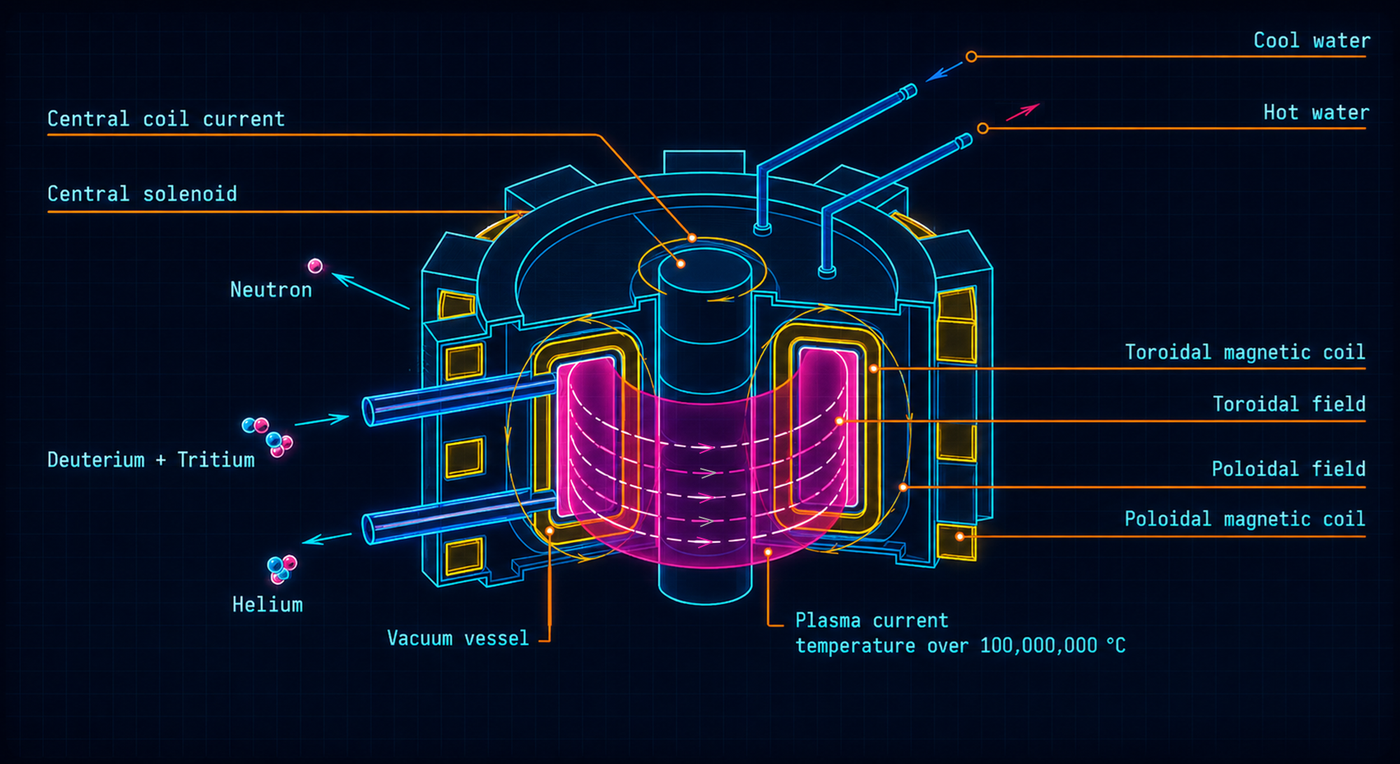
The neutron, with no charge, is invisible to magnetic fields. It flies out and slams into the reactor wall. That's not a bug — it's the plan. A surrounding structure called a blanket absorbs the neutrons, heats up, and drives a coolant loop. The coolant drives a steam turbine.
Strip away all the exotic plasma physics and the last step of a fusion power plant is the same one every nuclear or coal plant uses: boil water, spin a turbine.
D-T is not the Sun's reaction — the Sun fuses ordinary hydrogen, a far slower process propped up by gravitational confinement at astronomical scale. D-T is chosen because it has the lowest energy barrier of any fusion reaction practically achievable on Earth.
The problem: nuclei really don't want to get close
Every nucleus is positively charged. Like charges repel.
To fuse, two nuclei must get within a few femtometres of each other — close enough for the short-range strong nuclear force to take over. But the closer they get, the harder electrostatic repulsion pushes back. This energy barrier is called the Coulomb barrier.
Classically, overcoming it would require temperatures far beyond anything achievable. What saves us is quantum tunnelling: particles aren't perfectly localised classical objects. Their quantum-mechanical wavefunctions have a finite probability of penetrating a barrier even without enough energy to classically climb over it.
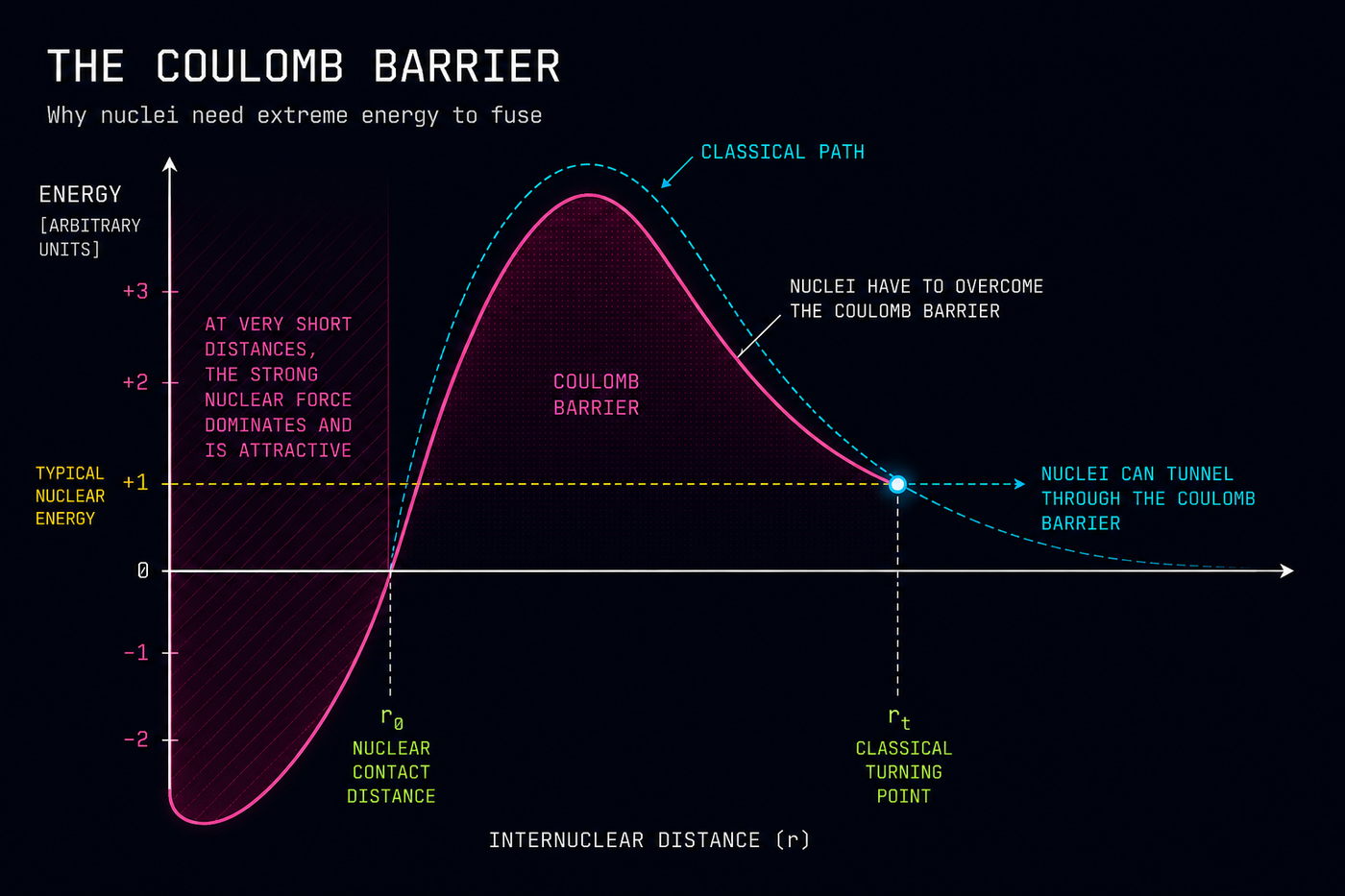
Without tunnelling, stars wouldn't ignite. Terrestrial fusion would be essentially impossible.
Even with tunnelling, the odds of any single collision producing fusion are low. The practical strategy is:
- Heat the fuel hot enough that particles are moving very fast
- Pack enough of them together that collisions are frequent
- Hold them in place long enough for the rare successful collisions to add up
That is the entire engineering problem. It just happens to be extraordinarily hard.
The three numbers that decide everything
In 1955, physicist John Lawson worked out exactly what it takes for a fusion reaction to produce more energy than it consumes. The answer comes down to three variables:
Temperature (T)
Hot enough for nuclei to have a real shot at tunnelling through the Coulomb barrier. For D-T fusion, that means plasma temperatures exceeding 100 million °C — several times hotter than the core of the Sun, because we can't rely on the Sun's crushing gravitational confinement.
Density (n)
Enough nuclei per unit volume that collisions happen at a useful rate. More particles, more chances to fuse.
Confinement time (τ)
Not a clock duration — a measure of thermal insulation. Defined as the plasma's stored energy divided by the rate it's leaking away. A machine can run for minutes and still have a terrible confinement time if it's haemorrhaging heat continuously.
Multiply them together:
nTτ — the triple product
There's a minimum threshold this must exceed before a plasma becomes self-sustaining. Fall below it, and you're always spending more energy maintaining the conditions than the fusion gives back. Clear it, and you're approaching ignition.
Two ways to get there:
- High density for a very short time
- Moderate density for a longer time
These two strategies produced two completely different engineering traditions.
Two paths, two philosophies
Magnetic confinement — the "long time, moderate density" route.
Powerful magnetic fields, usually shaped into a doughnut called a tokamak, hold a hot diffuse plasma in place for seconds at a time. The plasma can't touch the reactor wall — not primarily because it would melt it, but because contact would cool the plasma, release impurity atoms, and destroy confinement entirely. ITER, the 35-nation megaproject under construction in southern France, is the flagship magnetic confinement experiment.
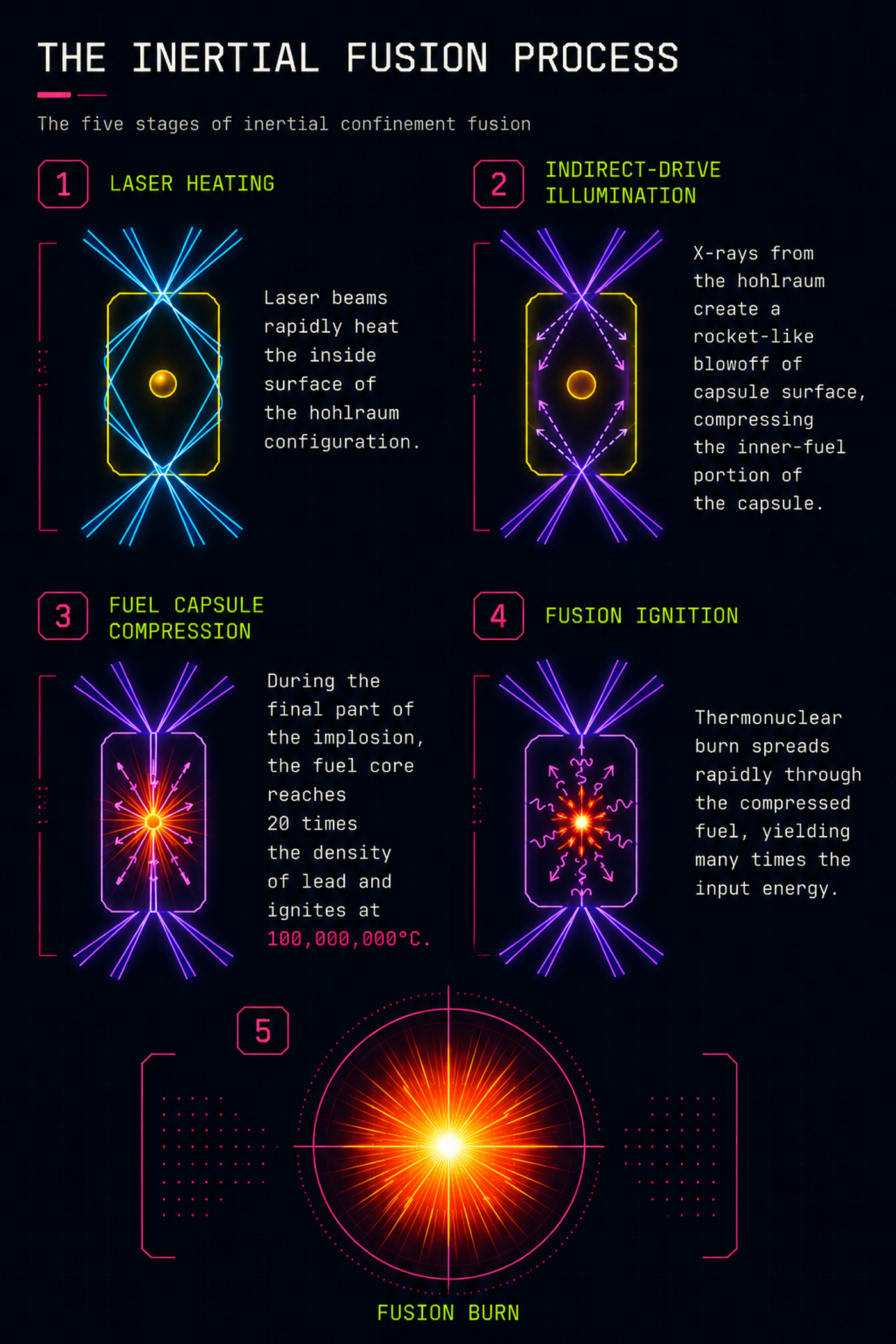
Inertial confinement — the "extreme density for a tiny moment" route.
A small pellet of D-T fuel is hit from all sides by powerful lasers and compressed to densities far beyond anything in a star's core. Fusion occurs before the pellet has time to fly apart. The whole event takes nanoseconds. The National Ignition Facility (NIF) in California uses this approach.
Can watch an illustration video here.
How close are we?
Fusion performance is measured by Q — fusion power produced divided by heating power delivered to the plasma.
- Q < 1 — you're losing energy
- Q = 1 — scientific breakeven: fusion output matches heating input
- Q = 10 — ITER's design target: ten times more fusion power than heating input
- Q = ∞ — ignition: the plasma sustains itself with no external heating
In December 2022, NIF crossed Q = 1 for the first time — the energy released by fusion reactions exceeded the laser energy delivered to the fuel pellet. Real evidence of burning-plasma behaviour. A genuine physics milestone.
But Q is a precise and limited measure. It counts energy delivered to the plasma — not everything the facility draws from the wall. NIF's lasers consume vastly more electricity than the experiment released, because converting wall-plug power into laser light is only a few percent efficient. Scientific breakeven and engineering breakeven — net positive electricity counting every pump, magnet, and cooling system on site — are completely different thresholds.
The gap between Q > 1 in a lab and "electricity on the grid" is where most of the hard problems still live.
ITER: the bellwether and its delays
On the magnetic side, ITER is the most instructive case study — not because it's succeeding on schedule, but because its delays are honest about where the difficulty actually sits.
Originally targeting first plasma around 2020, the project now targets the start of research operations in 2034, with full D-T fusion pushed back to 2039 (four years behind the previous 2035 target). The causes aren't exotic physics surprises. They're:
- COVID-disrupted supply chains
- Manufacturing defects in first-of-a-kind components — vacuum vessel sectors, thermal shields — that had never been built at this scale before
- Coordination across seven member governments and dozens of contractors
Meanwhile, a wave of private fusion companies is betting that smaller, faster reactor designs can beat the megaproject model to commercial power. ITER's own director-general has publicly called those timelines unrealistic. That dispute is live and unresolved — nobody yet has the results to settle it.
The honest takeaway
The physics of fusion has been understood since the 1950s. What's still being solved is the engineering: holding matter at conditions more extreme than anywhere else in the solar system except a stellar core, for long enough, consistently enough, and cheaply enough to run a power grid.
Every delay, every redesign, and every "breakthrough" headline is progress in that engineering problem — not evidence that the physics was wrong.
That distinction matters for separating genuine progress from hype. It's also the lens I'll bring to Part II, which looks at who's actually building reactors today and how their approaches differ.
Note: Fusion temperatures, gain values and breakeven thresholds depend on fuel choice, plasma regime and the precise system boundary being measured. This writing uses D–T fusion as the main reference case because it remains the benchmark reaction for many leading near-term fusion programmes.