Quantum 101: How Light Connects Quantum Machines
How light carries quantum information between devices: the technology behind processor links, quantum key distribution and connected sensors, with a 52-company landscape.

Fibre-optic networks carry information between data centres, cities and continents. Light can also carry quantum information, opening up ways to connect quantum processors, coordinate distant sensors and generate shared secret encryption keys.
These connections bring together photonics, the technology for generating, guiding and detecting light, and quantum protocols, the rules that determine how quantum information is exchanged and used. Understanding how they work together helps explain what quantum networks could do and where the companies building them fit in.
From optical connections to quantum connections
Why use light?
Many quantum processors store information in trapped atoms, ions, superconducting circuits or semiconductor spins. These systems can hold and manipulate qubits, the quantum version of bits, but they remain inside their machines. Connecting separate processors requires a way to transfer quantum information between them. Photons, the tiny packets of energy that make up light, can carry that information through fibre or across open space.
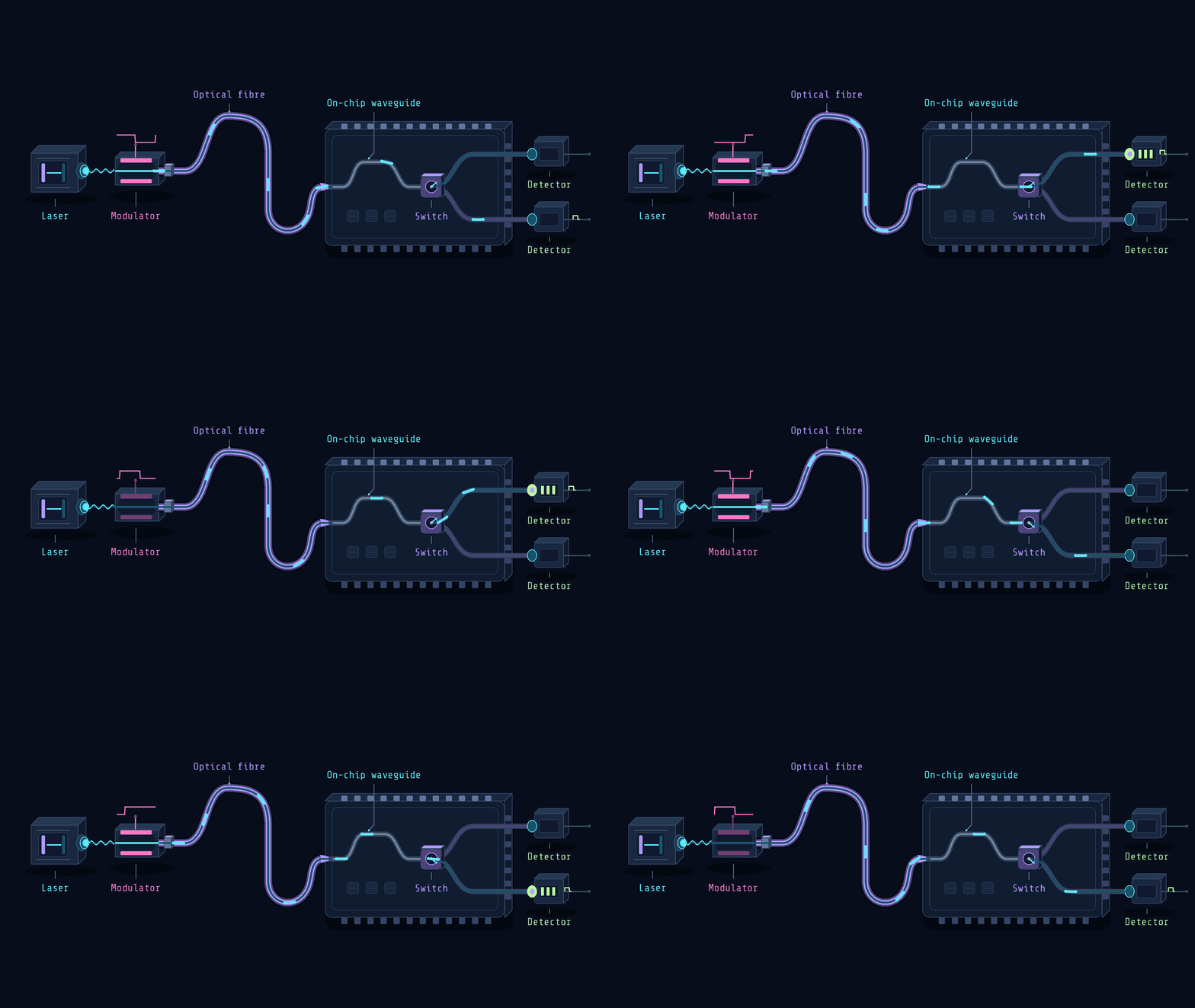
The technology for generating, controlling and detecting light is called photonics. Light sources produce photons, optical components guide and manipulate them, and detectors measure what arrives. Some components can fit onto a photonic chip, where tiny channels called waveguides carry light between them. Ordinary internet connections also use photonics. What makes a connection quantum is how it carries and uses quantum states.
How a photon carries a qubit
A photon can carry a qubit encoded in properties such as its polarisation, the path it takes or its arrival time. For example, an early arrival can represent 0 and a late arrival can represent 1. The photon can also occupy a superposition, a quantum combination of those possibilities. The link must preserve the relationship between them for the intended operation to work.
An unknown qubit cannot be copied perfectly, and measuring it does not reveal enough information to recreate it exactly. A quantum network therefore cannot simply read an incoming qubit and send an identical replacement onward.
How an entanglement link works
One way to connect quantum processors is to establish entanglement between qubits stored in different machines. Entangled qubits share a quantum state that cannot be fully described as two independent states. The network can use this shared resource to support operations across the machines.
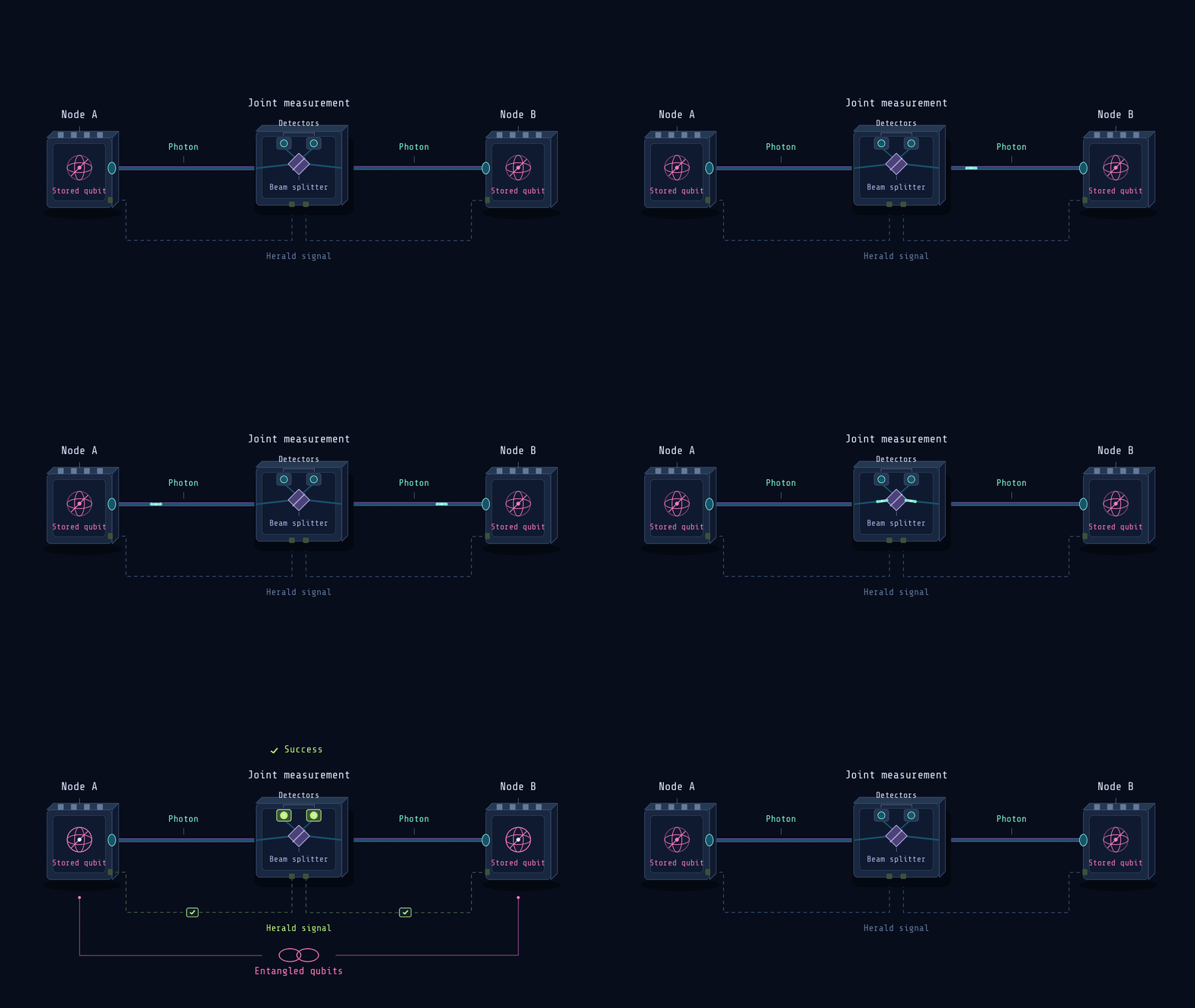
In one common approach, each node entangles a stored qubit with a photon and sends that photon to a shared measurement station. The station brings the two photons together and measures them. A suitable measurement result signals that the stored qubits are now entangled. Ordinary messages then tell the nodes that the attempt succeeded.
That success signal is called heralding. The photons are consumed in the measurement, while the useful entanglement remains between the stored qubits. Other architectures establish quantum connections differently, including by distributing entangled photon pairs directly.
Shared entanglement can support quantum teleportation, which transfers a quantum state to another qubit using local operations and ordinary messages. It does not leave a separate copy of the original state or allow information to travel faster than light.
Connecting the processor to the light
These connections require an interface between the processor and the travelling light. Some systems need to change a photon’s wavelength; superconducting processors may need to transfer quantum information from microwave signals into optical form.
Some protocols also require quantum memory to hold a state while another connection succeeds. Sources, interfaces, memories and detectors must work together to create a link useful for the intended application.
The applications of quantum connection
Quantum communication has three main uses: connecting quantum processors, generating encryption keys and linking sensors. Each needs a different kind of connection.
Connecting processors
Quantum links could let smaller processors work together on one computation, helping engineers build larger systems without putting every qubit into a single machine. Shared entanglement enables operations between qubits in different modules.
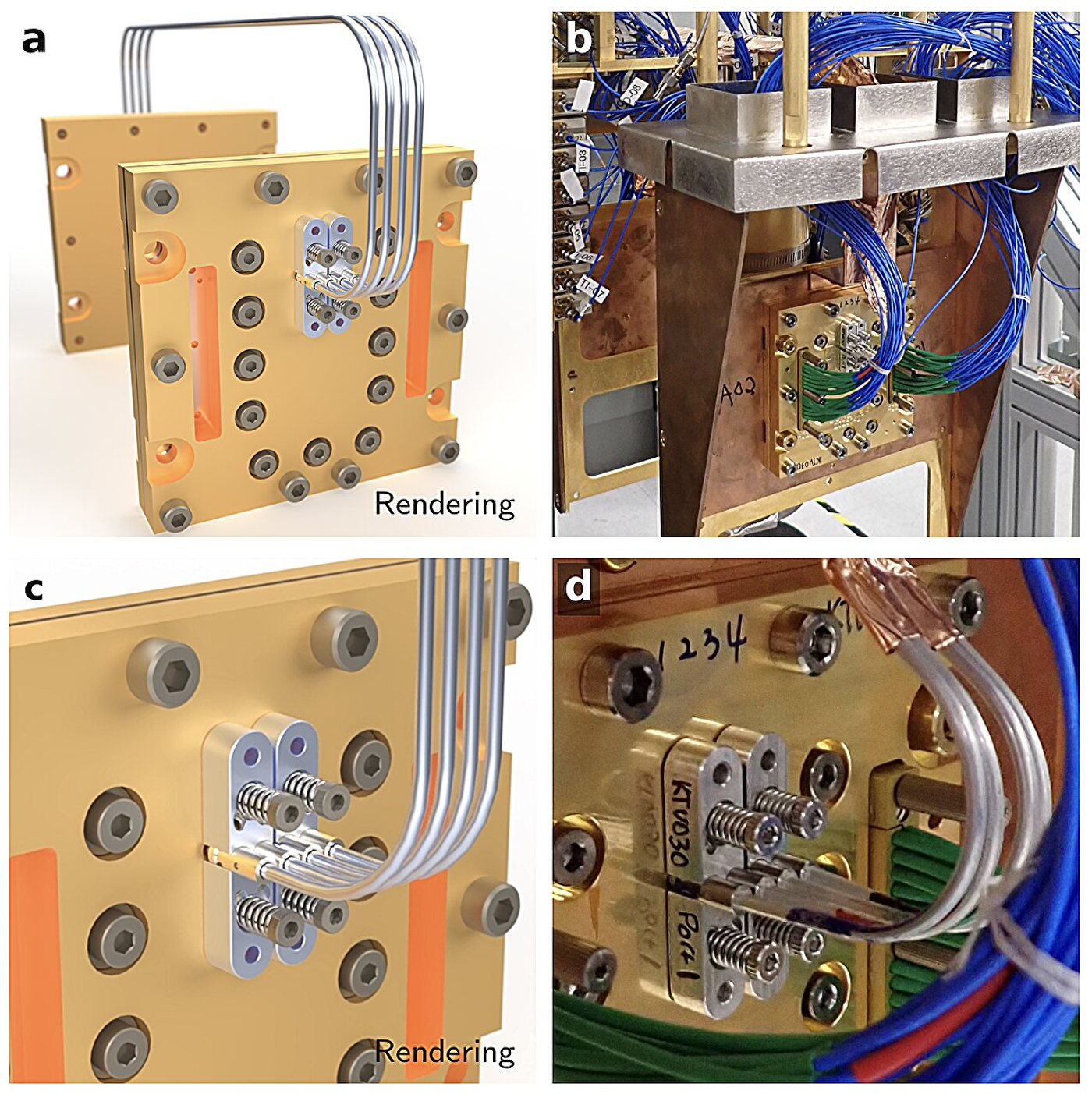
In 2025, Oxford researchers demonstrated a small distributed quantum algorithm using two trapped-ion modules connected by light. Scaling this up means connecting more modules while keeping errors and delays low. The immediate users are quantum-computer builders and research teams; wider benefits depend on what the combined computer can actually do.
Generating encryption keys
Quantum key distribution, or QKD, uses quantum signals and ordinary messages to help two parties create shared secret keys. Conventional encryption then uses those keys to protect data. Different QKD designs use different optical signals and protocols.
Commercial equipment and some telecom services already exist, serving customers with demanding security needs. But QKD still requires authentication, secure endpoints and careful implementation. Some networks also rely on trusted intermediate nodes.
Post-quantum cryptography, or PQC, takes a different approach: mathematical algorithms running on ordinary computers. It needs no quantum link. Services can use both, so “quantum-safe” does not necessarily mean they transmit quantum states.
Read my post about QKD and PQC here.
Connecting sensors
Sharing entanglement or another quantum resource could help distant instruments make better measurements, such as comparing clocks or measuring physical fields. Any advantage must survive the connection’s losses and noise.
This goes beyond sending ordinary readings from quantum sensors over the internet. The instruments share a quantum resource as part of the measurement itself. Early applications are likely to involve specialist research and precision-measurement teams.
How the light travels
These applications can use fibre or free-space optical links, including satellite connections. Fibre provides controlled paths through buildings and cities. Free-space links transmit beams through the atmosphere, while satellites could extend connections over distances that are difficult to cover through fibre.
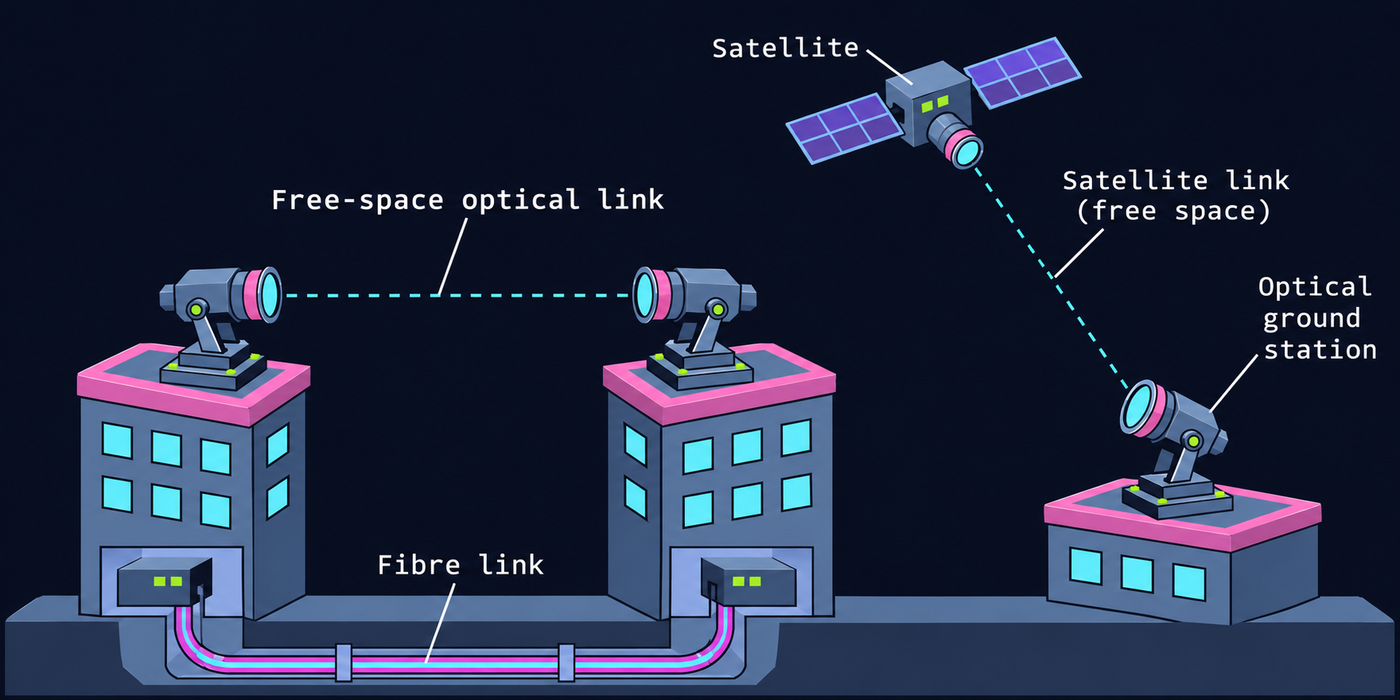
The route determines many engineering challenges, but the protocol determines the job. A satellite distributing encryption keys, for example, does not automatically connect quantum processors for shared computation.
The builders of quantum connectivity
The landscape contains 52 selected companies and company groups, covering quantum links, QKD systems, enabling hardware, space programmes and network deployment.
A commercial detector, a processor-interface prototype and an operational QKD service represent different stages of development. Some enabling suppliers also serve classical photonics markets.
52 selected companies and company groups across six roles, as of 8 November 2026. Covers quantum communication systems, enabling components, satellite programmes and network deployment.
▣ Quantum interconnects, memories and network control
▣ Quantum key distribution systems
▣ Photon sources, detectors and timing
▣ Photonic chips, manufacturing and control
▣ Satellite and free-space quantum links
▣ Network equipment, integration and deployment
What holds back the technologies?
Loss builds up along the connection
Photons can be lost in fibre, connectors, switches and interfaces, while detectors may miss some that arrive. These effects compound, so performance depends on the entire path from source to receiver.
Ordinary telecom amplifiers cannot faithfully amplify an unknown quantum state. Quantum repeaters aim to extend connections through intermediate quantum operations. Many designs create shorter entangled links and join them using entanglement swapping, often with memories to coordinate successful attempts. Others use more complex photonic states and error correction. Turning these approaches into dependable networks remains a major engineering challenge.
Unwanted light creates noise
A receiver detecting individual photons can mistake background light for a signal. Outdoor and satellite links must contend with sunlight; fibre links can face noise generated by conventional communications sharing the cable.
Engineers use wavelength filters, narrow viewing angles and precise detection windows to reject unwanted light. These measures make challenging conditions more manageable, but must balance noise rejection against collecting enough useful signal.
The connection needs constant adjustment
Many entanglement protocols require photons to arrive with closely matched timing, frequency and polarisation. Temperature changes, vibration and movement can disrupt that match, reducing the quality of the quantum operation.
Networks therefore need accurate timing, calibration and active stabilisation. Outdoor links also face turbulence, alignment changes and weather. Clouds can block a satellite’s optical connection entirely.
Memories and interfaces add their own constraints
A quantum memory must capture a state efficiently, preserve it and make it available when needed. Storage time matters alongside the accuracy and efficiency of the whole process.
Interfaces must transfer quantum information between devices while limiting loss and noise. Some processors, sources and detectors also need cooling, even though the connecting fibre operates at room temperature. These requirements affect both installation complexity and running costs.
Useful networks need dependable performance
A working service must recover from interruptions, coordinate equipment and track whether its quantum resources remain usable. The most meaningful performance measures depend on the application:
- Connecting processors: how quickly usable entanglement is produced, its quality, the errors and delays in remote operations, and how performance changes as more modules join.
- QKD: how quickly secure keys are generated, how the system authenticates users and protects those keys, and what deployment and operation cost. Key-generation speed is separate from the speed of the encrypted data connection.
- Connecting sensors: whether the quantum link improves the final measurement once real-world loss and noise are included.
What happens next?
I expect quantum networking to grow through focused applications. Sources, detectors and control systems can serve customers while larger networks take shape. QKD services will need to justify their security benefits and costs alongside growing use of post-quantum cryptography. Links between processors will likely develop first in controlled settings such as labs and data centres, while connected sensors will gain traction where they demonstrably improve measurements.
For me the most useful signs of progress are practical: processors working reliably together, security services worth their installation and running costs, and sensors delivering better results despite the connection’s loss and noise. These outcomes will tell us more about the technology’s value than distance records or another network announcement.