
Vinci is Making Physics Simulation Fast Enough for AI Hardware
Vinci is building AI-powered simulation software that lets hardware engineers test heat, stress and other physical behaviour in seconds instead of waiting hours or days.
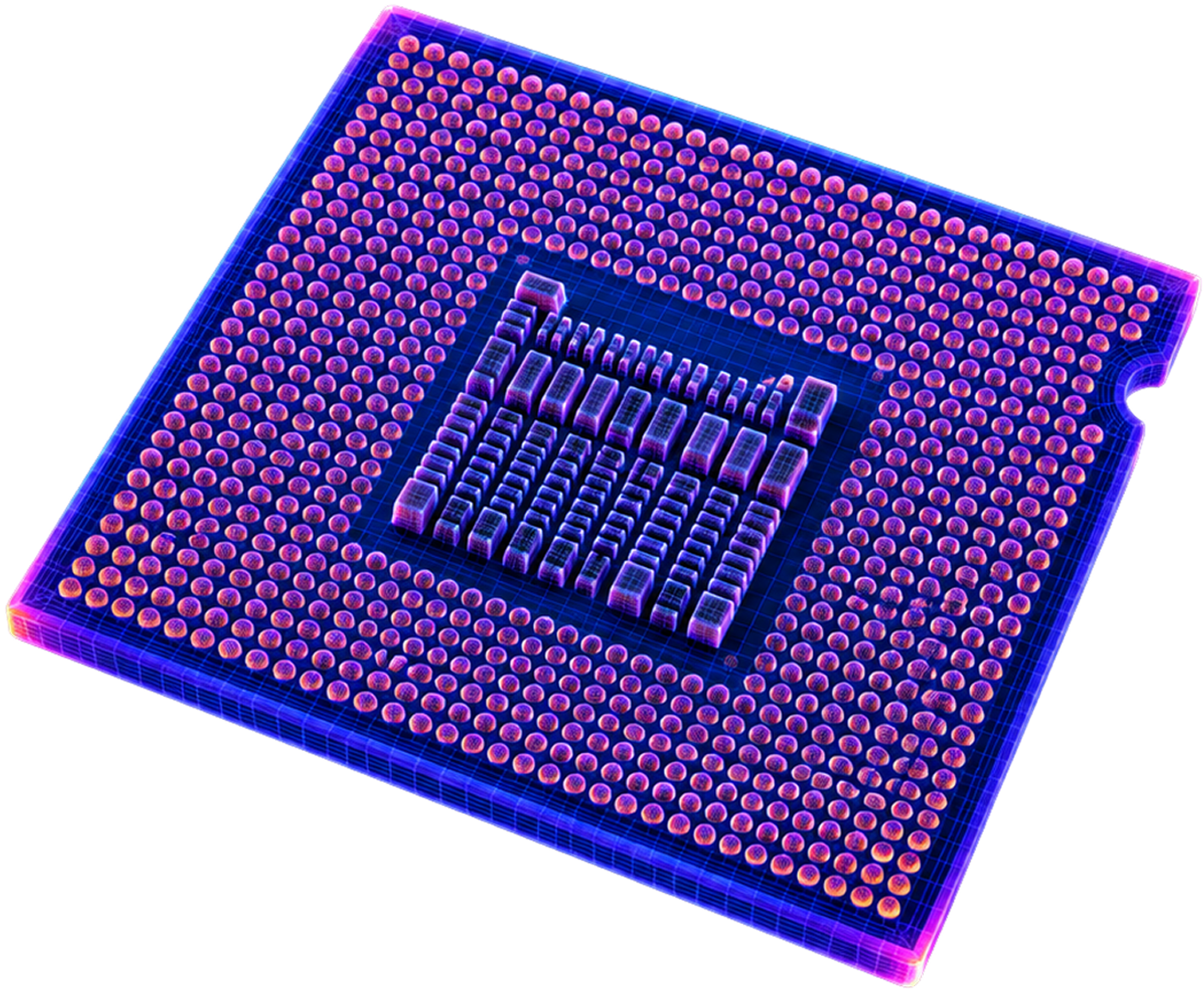
Something sounds very similar as PSI (physics, AI, simulation) but completely different. :p
I think the idea of Vinci is more straightforward. Chips generate heat, materials expand, packages warp, and components interact in ways that can cause a design to fail after manufacturing. Engineers use simulation to catch these problems before production, but traditional tools can require extensive manual setup and long compute times. Vinci is trying to remove that bottleneck.
Founded in 2023 and based in Palo Alto, Vinci builds AI-powered physics simulation software for semiconductor and hardware engineers. The company emerged from stealth in late 2025 and have just raised a $250 million Series B at a $1.5 billion valuation announced today.
What is Vinci?
Vinci is essentially trying to make engineering simulation much faster and easier to use.
Before a chip or hardware system is manufactured, engineers need to predict how it will behave physically. For example:
How hot will different parts of the chip become?
Where will thermal hotspots appear?
Will a package bend or warp as temperatures change?
How will different materials behave together?
Will the system remain within safe operating limits?
Traditionally, engineers answer these questions using tools such as finite-element analysis (FEA). The design is converted into a numerical model, often divided into millions of small elements through a process called meshing, and a solver calculates how heat, stress or other physical effects move through it.
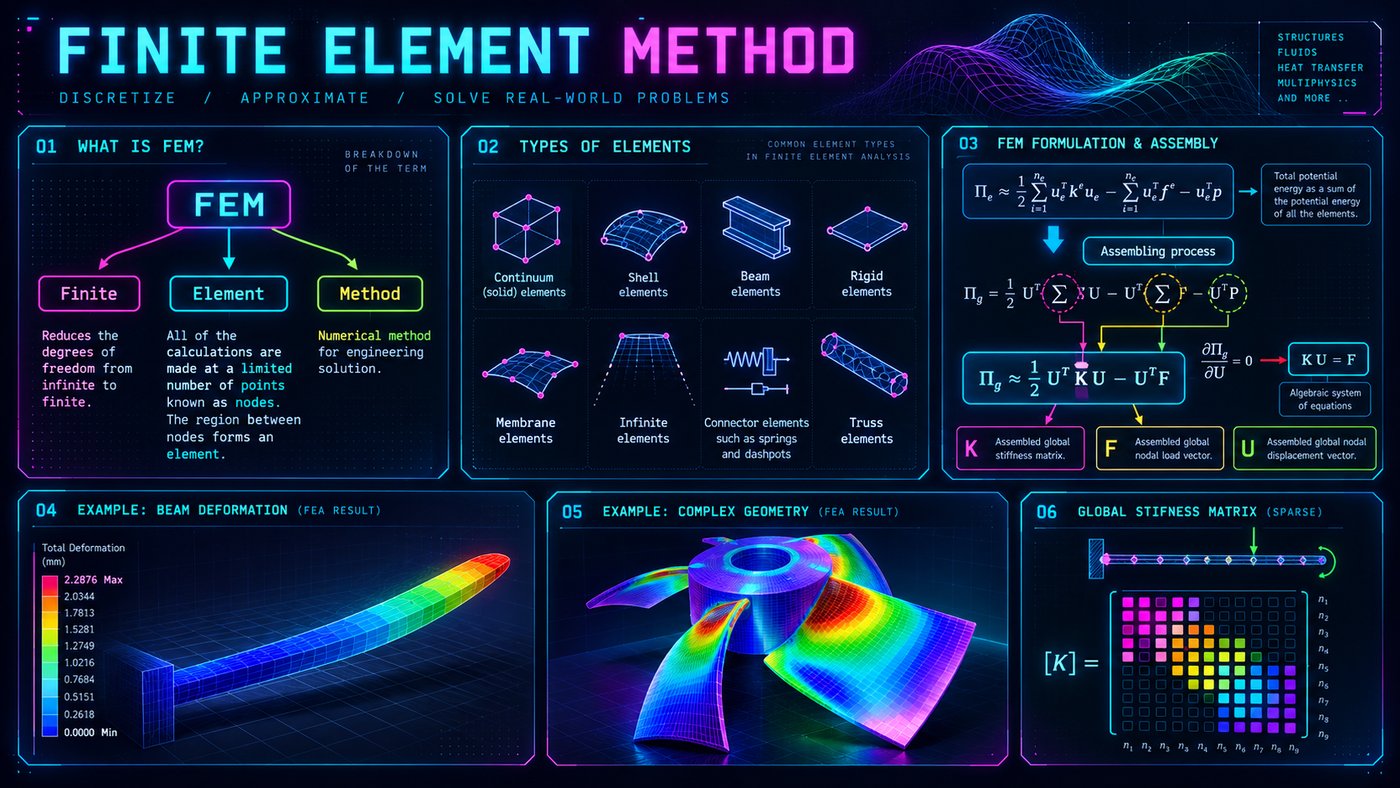
The problem is that preparing and running these simulations can take hours or days, particularly as modern chips become more complex.
Vinci replaces much of that workflow with what it calls a Foundation Model for Physics. The software ingests engineering files directly, understands the geometry and materials, and predicts the physical behaviour using a combination of AI, physics equations and GPU computing. Vinci says the same pre-trained model can handle new designs within its supported physics domains without being retrained for every customer or geometry.
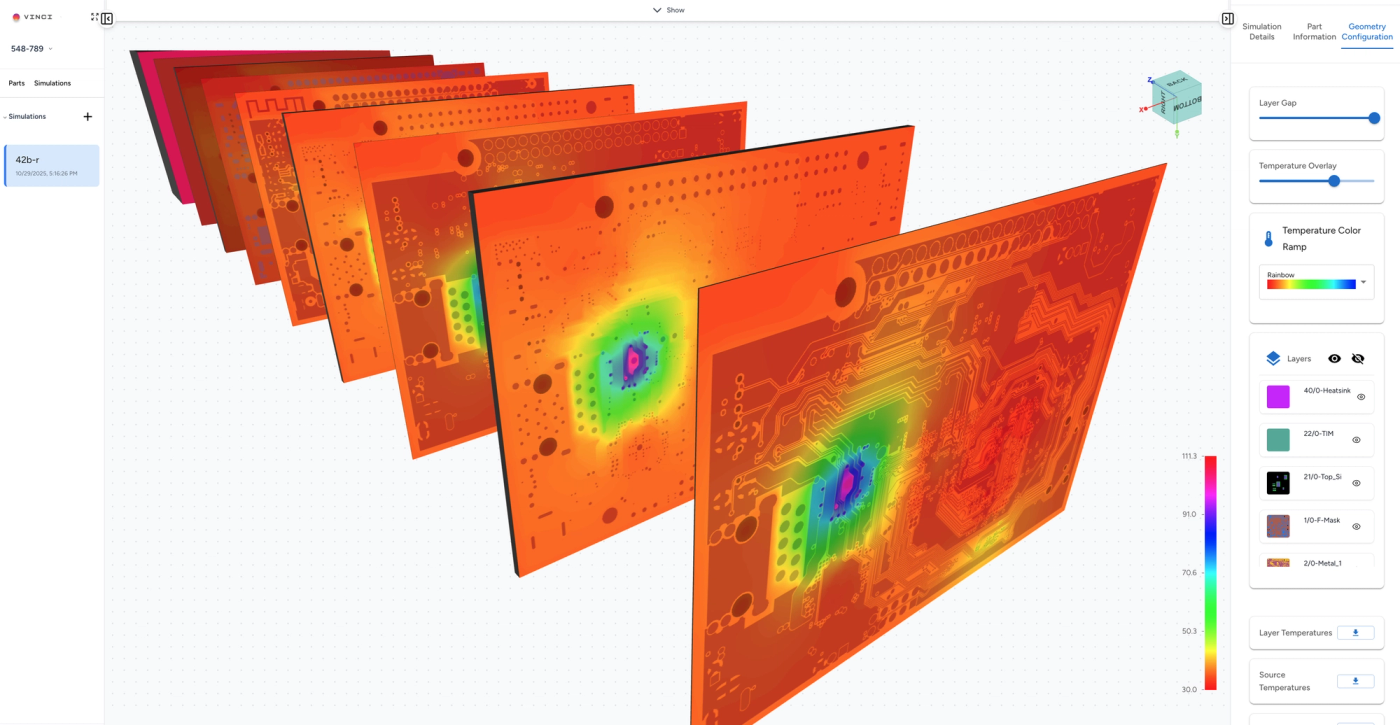
The workflow becomes:
hardware design → Vinci reads the geometry → physics model calculates behaviour → engineer sees the result → design changes → simulate againThe key difference is speed. Vinci says its simulations can run up to 1,000× faster than conventional FEA workflows, while still producing deterministic, solver-level results. In one published semiconductor study, it ran 9,101 large thermal simulations in 26 hours, averaging about 10 seconds per simulation.
Today, Vinci supports areas including thermal conduction, convection and thermo-mechanical behaviour such as warpage. Its longer-term ambition is to cover more of the physics involved in hardware systems.
What is the business?
Vinci started with semiconductors and advanced electronics, where the problem is becoming particularly acute.
Modern AI accelerators pack processors, chiplets and high-bandwidth memory into increasingly dense packages. More computing power means more heat, while advanced packaging creates difficult interactions between thermal behaviour, materials and mechanical stress.
Faster simulation can mean more designs tested, earlier detection of thermal or mechanical problems, less engineering time spent preparing simulations and fewer expensive redesigns later.
Vinci says its software is already deployed in production engineering programs at leading semiconductor companies. More than half of the world's top 20 semiconductor companies have benchmarked the technology against traditional FEA tools and experimental results, although most customer names remain undisclosed.
Its deployment model is also important. Vinci runs on the customer's own infrastructure, either on-premise or on AWS, Azure or Google Cloud. Customer designs remain behind the customer's firewall and are not used to train Vinci's model.
That makes Vinci fundamentally a software business, rather than a consulting model where engineers need to build a new solution for each customer.
Who founded it?
Vinci was founded in 2023 by Dr. Hardik Kabaria and Dr. Sarah Osentoski, while the company's current leadership also lists Vincent Rerolle as co-founder and Chief Commercial Officer.
Hardik Kabaria, Founder & CEO, has a background in computational geometry, simulation and AI. His Stanford doctoral research focused on one of the difficult parts of traditional simulation: automatically creating high-quality meshes for complex geometries.

Sarah Osentoski, Co-founder & CTO, comes from machine learning, robotics and autonomous systems and leads Vinci's technical work across AI and physics.
Vincent Rerolle, Co-founder & CCO, leads commercialization and industry engagement.
The combination reflects the problem Vinci is solving: simulation expertise + machine learning + enterprise engineering software.
Market Landscape
Vinci sits at the intersection of engineering simulation, semiconductor design software and Physics AI.
Its customers are companies designing increasingly complex physical hardware, its suppliers provide the compute and engineering inputs required to run simulations, and its competitors range from established EDA and simulation platforms to newer AI-native engineering companies.
Vinci sits between semiconductor design software, engineering simulation and Physics AI. The landscape covers representative target customers, suppliers and enablers, and competitors. Customer entries are potential targets only and do not imply a confirmed commercial relationship.
▣ Customers
▣ Suppliers & Enablers
▣ Competitors
What are the constraints?
Accuracy has to be extremely high
Hardware cannot be patched after manufacturing in the same way software can. If Vinci misses a hotspot or predicts the wrong amount of warpage, the result could be an expensive failed design.
Speed therefore matters only if engineers trust the answer. Vinci needs repeated validation against traditional solvers, experiments and ultimately manufactured hardware.
It must work beyond familiar test cases
Vinci’s main technical claim is that a single pre-trained model can accurately handle NEW geometries, materials, and operating conditions without being retrained for each customer.
This would be a major advantage, but only if the model performs reliably in unfamiliar situations. If it works well only on configurations similar to those it has already seen, it would offer little improvement over a traditional, narrowly focused simulation model.
Physics coverage is still limited
Thermal and thermo-mechanical analysis are strong starting points, but real hardware involves many interacting domains: fluid dynamics, vibration, electromagnetics, structural mechanics and more.
To later scale, Vinci has to add these domains without sacrificing speed or reliability.
Incumbents already own the workflow
Cadence, Synopsys and Siemens have spent decades becoming embedded inside engineering organisations.
Even if Vinci produces better simulations, companies may not want to replace their existing design stack. Vinci therefore needs strong integrations and may initially succeed alongside existing EDA tools rather than replacing them.
Compute is forever expensive
Vinci makes simulation much faster, but it still uses GPU compute, same constraints with PSI or any AI startups. The cost advantage needs to remain compelling as simulations become larger and customers run thousands more of them.
How to be commercially successful?
Vinci first needs to win one narrow but valuable use case: thermal and thermo-mechanical simulation for advanced chips and packaging. The commercial outcome should be easy to measure:
faster simulation → more designs tested → problems found earlier → less redesign → faster product developmentFrom there, four things matter.
Trust: engineers must accept Vinci's output for real production decisions, not just experimentation.
Integration: Vinci needs to fit naturally inside existing design tools and workflows.
Physics expansion: the platform needs to move from heat and warpage into a broader set of coupled physics.
Repeatability: the same software should work across customers and new designs without bespoke training or large engineering teams.
If Vinci achieves all four, it can move from being a fast thermal simulation product to becoming a general physics layer for hardware engineering.
Final take
The strongest argument for Vinci is simple. AI is making it cheaper to generate designs. That means engineers can consider far more possible chips, packages and systems than before.
Vinci is betting that physics simulation will therefore move from an occasional specialist task to something running continuously in the background of hardware design.