
Thinking Machines Lab: Not a Chatbot, Maybe a Real Collaborator
In short word: They are building a real collaborator who can listen, watch, talk to you and think at the same time. No longer just a chatbot.

I used to be annoyed by Thinking Machines Lab.
A company with no obvious revenue, no public traction, no clear business model — and somehow it raised $2B in seed funding at a $12B valuation, chasing a potential $50B valuation.
However, look at this research preview on interaction models, I think I get it more now.
This is not just a company building another chatbot with a prettier UI. Thinking Machines is trying to build what I would call an artificial collaborator — a system that can listen, watch, talk, think, interrupt, use tools, and respond in real time. Not “type prompt, wait, receive answer.” More like working with someone sitting next to you who can see what you see, hear what you say, and think alongside you.
Their core argument is that today’s AI has a collaboration bottleneck. Most models are turn-based: you speak, it waits; it speaks, you wait. But real collaboration is messy. People interrupt, backchannel, point at things, pause, correct themselves, and think out loud. Thinking Machines wants models to handle that natively through continuous audio, video, and text streams.
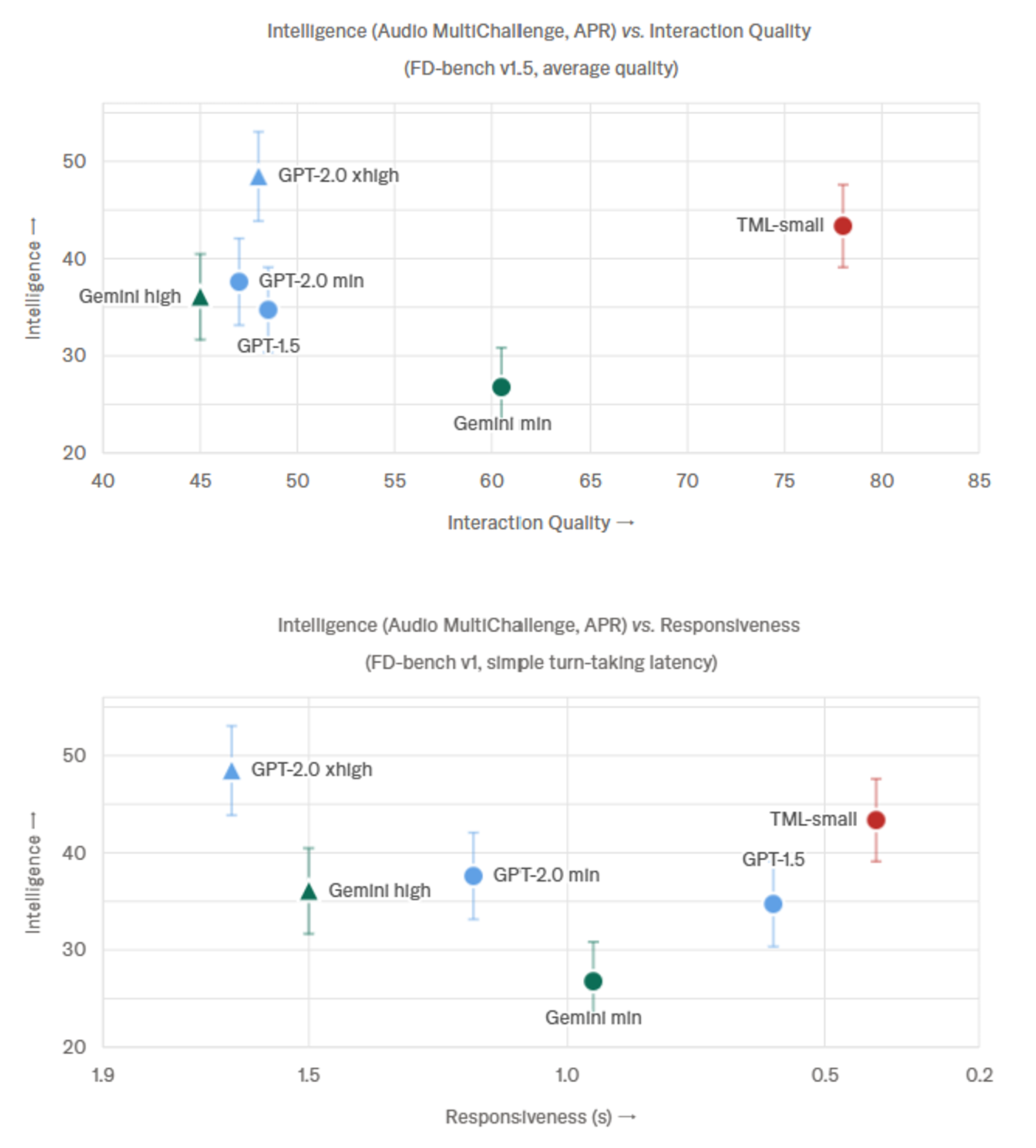
Our model dominates interaction quality while being more intelligent than any non thinking model. We achieve the best responsiveness measured as a latency between user and model turns.
The interesting part is the architecture. Their model uses 200ms micro-turns, so it can process and generate in tiny real-time chunks instead of waiting for a full user turn. It also pairs a real-time interaction model with a background model that can handle deeper reasoning, tool use, browsing, and longer tasks while the main model keeps talking to the user.
In short: they are not building artificial intelligence as a box you query. They are building AI as a live collaborator.
Of course, I’m still skeptical. A $2B seed round is not pocket money. OpenAI is reportedly dealing with enormous losses and infrastructure costs even after years as a market leader, so $2B may not go that far in frontier AI land. The competition is brutal, the compute bill is unholy, and down rounds are not impossible if the magic does not turn into product fast enough.
But I also think calling this just an “AI bubble” is too lazy.
A bubble means something is priced far above its intrinsic value. But what is the intrinsic value of a technology that could change how humans work with machines altogether? How do you price a new interaction layer for knowledge work, research, education, design, healthcare, coding, robotics, and maybe basically everything?
Maybe the valuation is insane.
But maybe the target is also insane.
And honestly, investing in something that could unlock a new chapter of human-computer collaboration does not feel expensive in the same way buying another SaaS dashboard at 50x revenue does.
Thinking Machines Lab, "Interaction Models: A Scalable Approach to Human-AI Collaboration",
Thinking Machines Lab: Connectionism, May 2026.