
Nine Atoms, Two Dimensions: ZuriQ’s Quantum Breakthrough
A tiny Swiss startup just raised $25.5 million on a bet that has little to do with who has the biggest qubit count today—and everything to do with how quickly that count can grow.
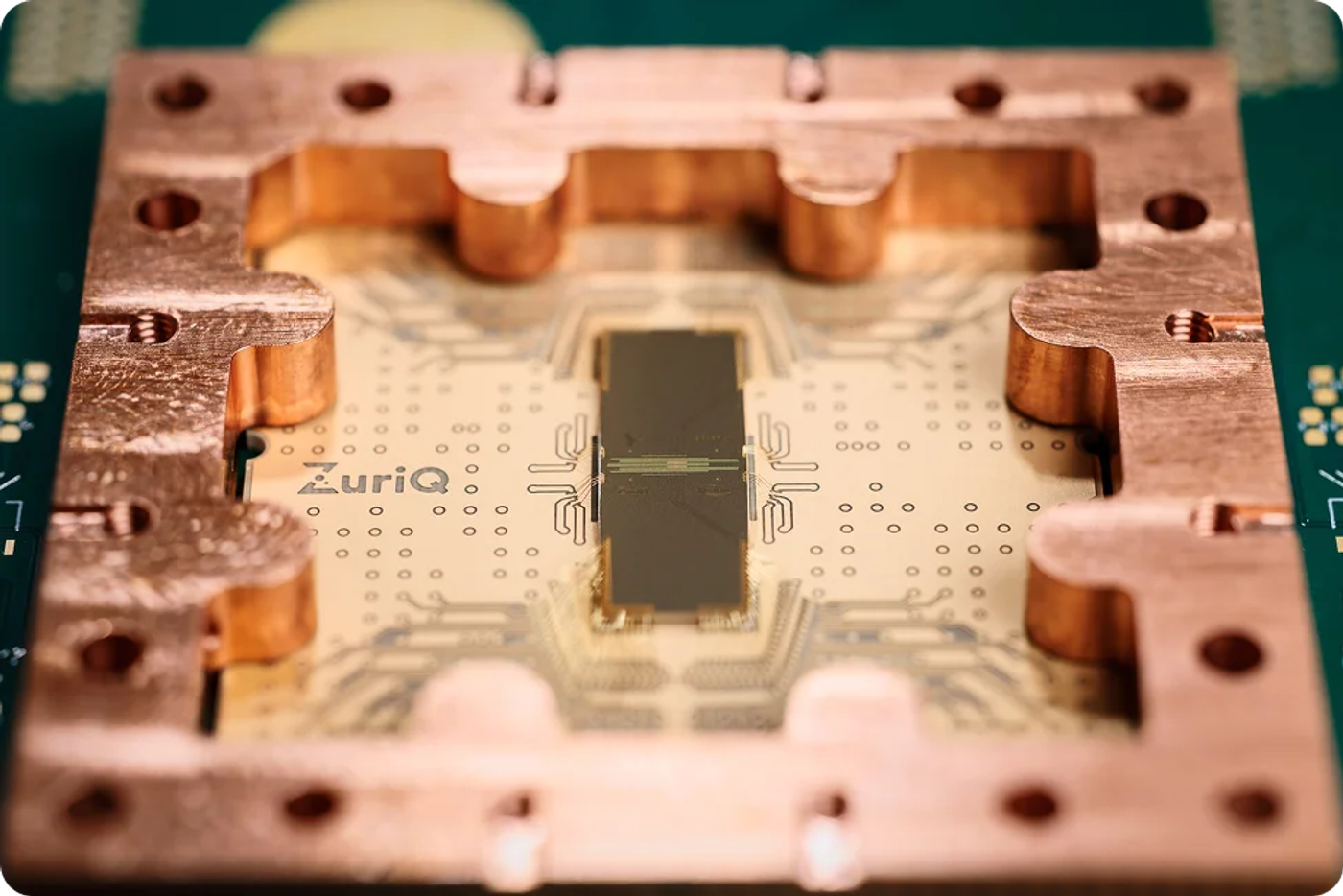
A tiny Swiss startup just raised $25.5 million on a bet that has little to do with who has the biggest qubit count today—and everything to do with how quickly that count can grow.
What ZuriQ is doing?
ZuriQ is a Zürich-based quantum computing startup spun out of ETH Zürich in 2024. Like several of the strongest companies in the field, it builds quantum computers using trapped ions: single charged atoms held in place and used as qubits. Trapped ions are already one of the most accurate ways anyone has found to build a quantum computer. IonQ and Quantinuum, the two established leaders, use them too.
What ZuriQ changed is the geometry. For roughly twenty years, trapped-ion machines have arranged their atoms in a single line, like beads on a string. ZuriQ puts them in a native two-dimensional grid instead: atoms spread across a flat chip and able to move in different directions.
That one change is basically the whole company. Eighteen months after showing investors a system with exactly one atom—and only weeks after publishing peer-reviewed research supporting the physics—ZuriQ raised $25.5 million to keep building.
The technology, broken down
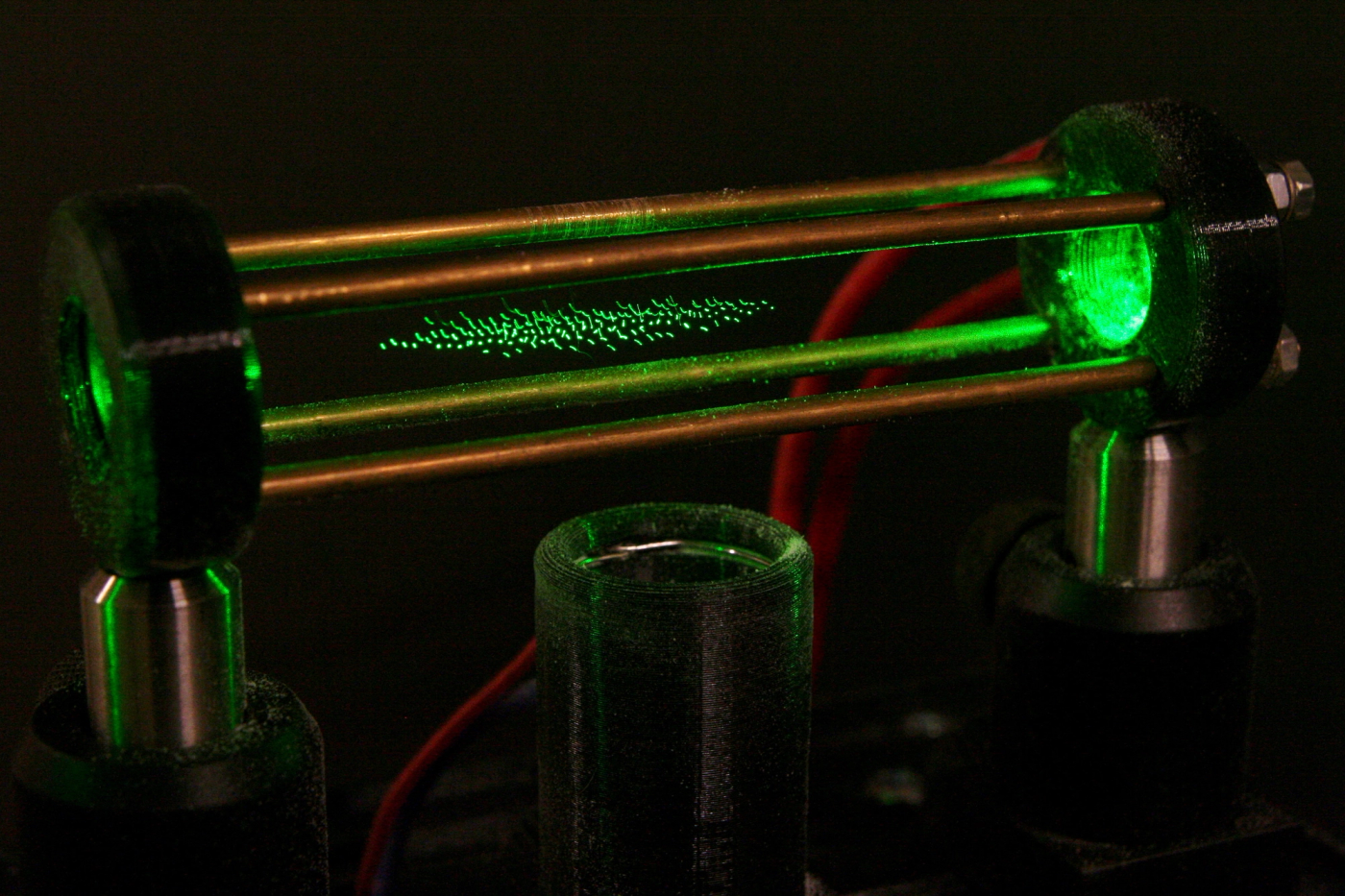
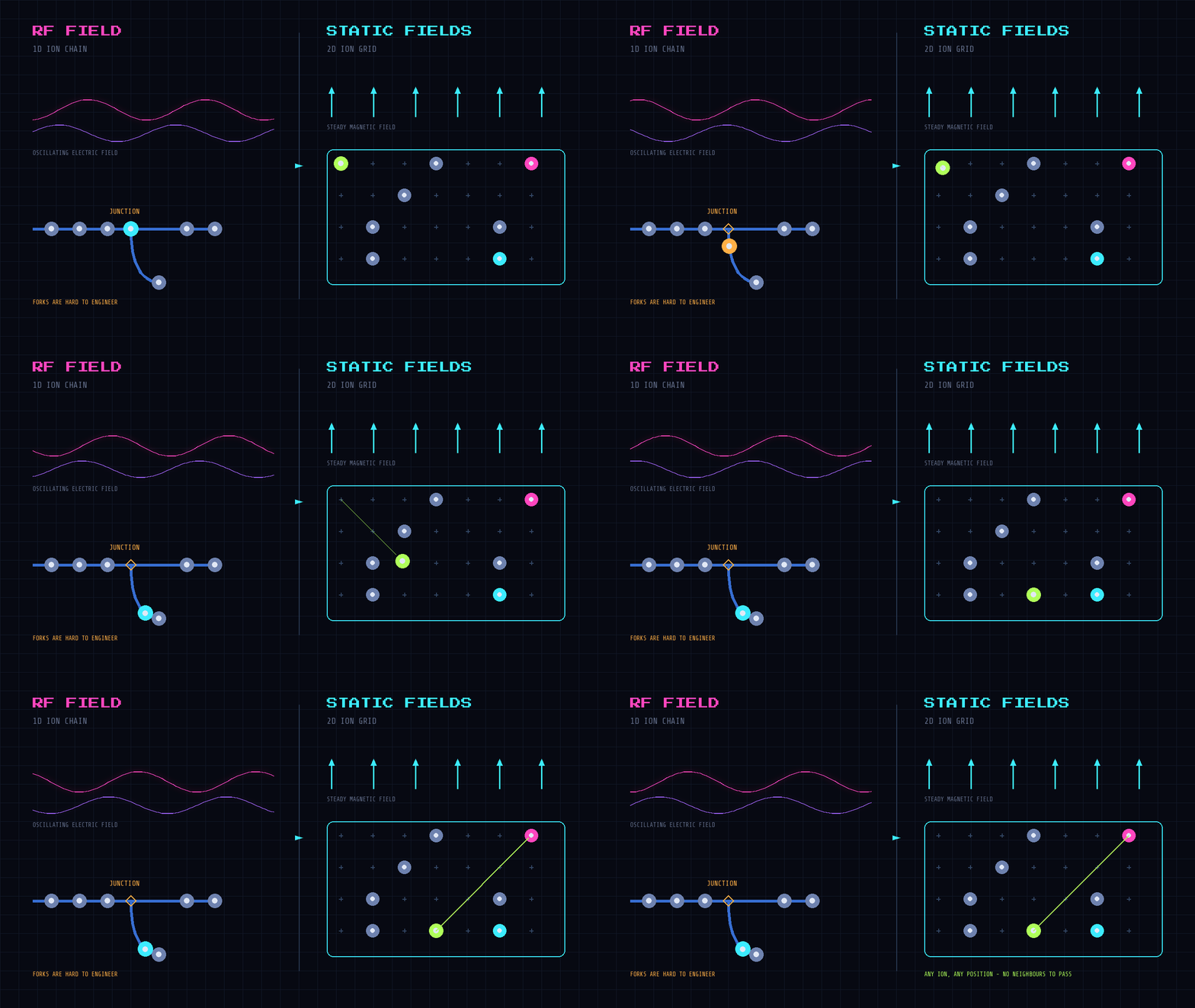
The standard trapped-ion design used by IonQ and Quantinuum is called a Paul trap. It holds an ion in place using an electric field that oscillates billions of times per second. That oscillation creates the trap, but it also pushes the atoms into a single line.
To add more qubits, you can make the line longer, which becomes unstable, or connect several lines through a junction—basically a road intersection for atoms. Those junctions are extremely difficult to engineer.
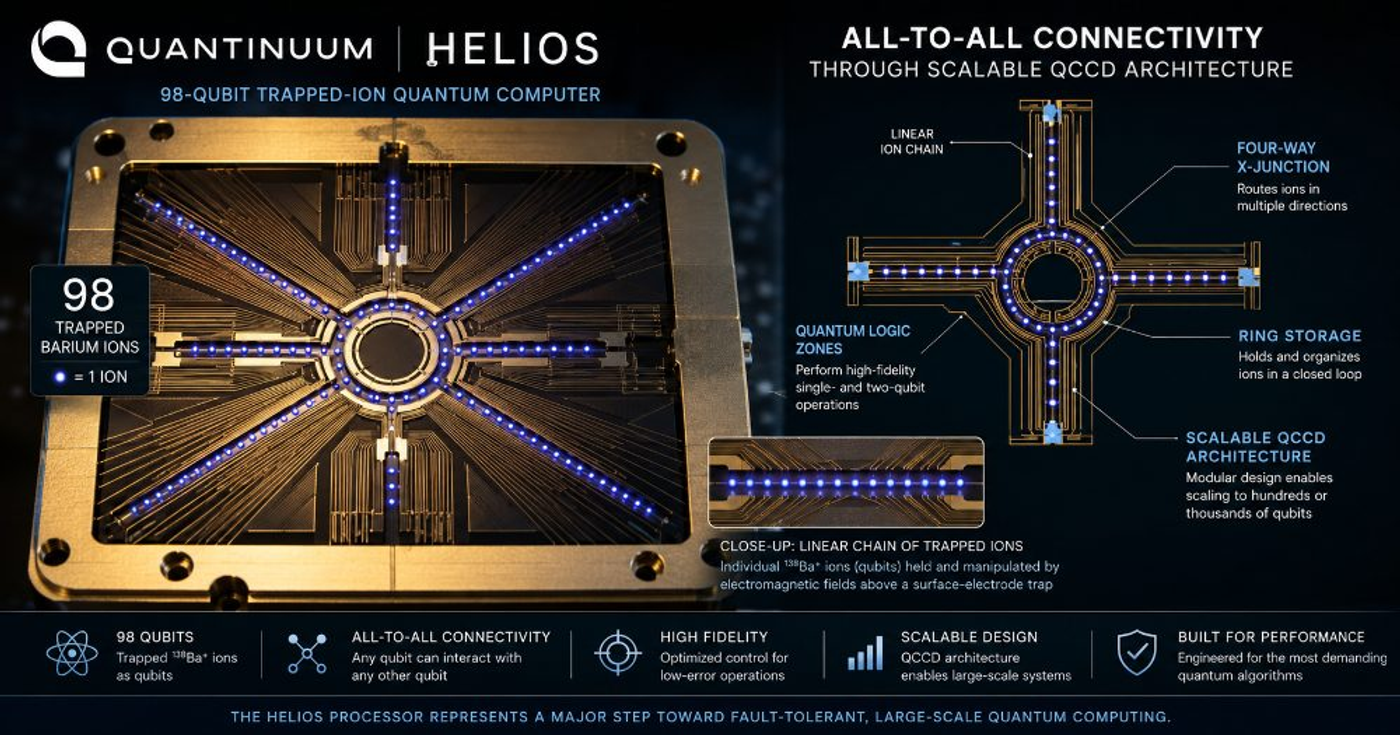
Quantinuum’s Helios, the current record-holder at 98 qubits, uses a rotating storage ring and a junction to move atoms between two working areas. A large part of the machine’s internal complexity is therefore spent managing traffic rather than doing computation.
ZuriQ uses a different design called a Penning trap. Penning traps are not new: they are well-established physics used in areas such as mass spectrometry and antimatter experiments. ZuriQ’s contribution is shrinking the system down and arranging it across a chip.
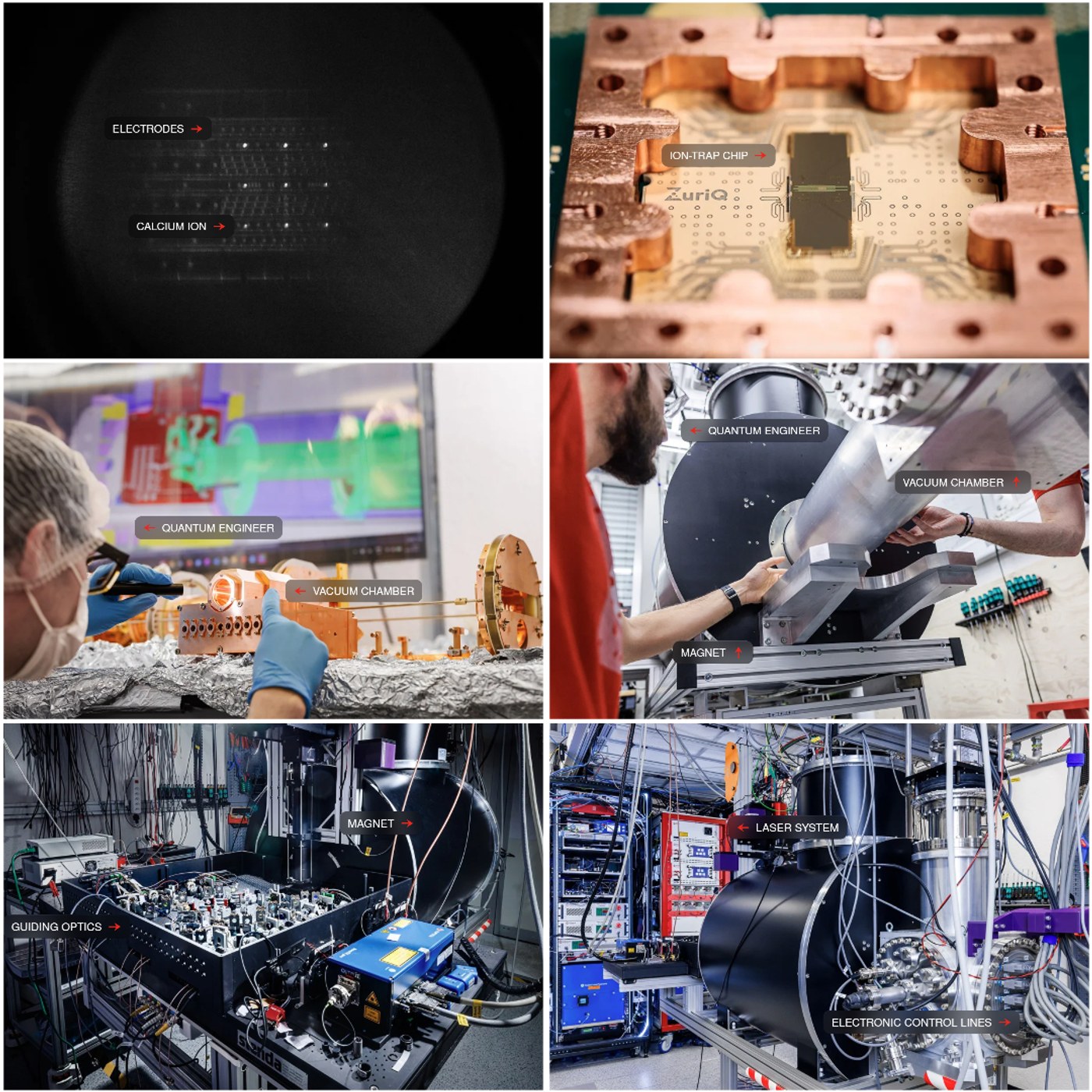
Instead of a rapidly flickering electric field, the system uses static fields: a microchip covered with electrodes, placed inside one large, steady magnetic field generated by a superconducting magnet. Because nothing is oscillating, the atoms are not forced into a line. An ion can be held above different parts of the chip, while changing the electrode voltages allows it to move around freely in three dimensions.
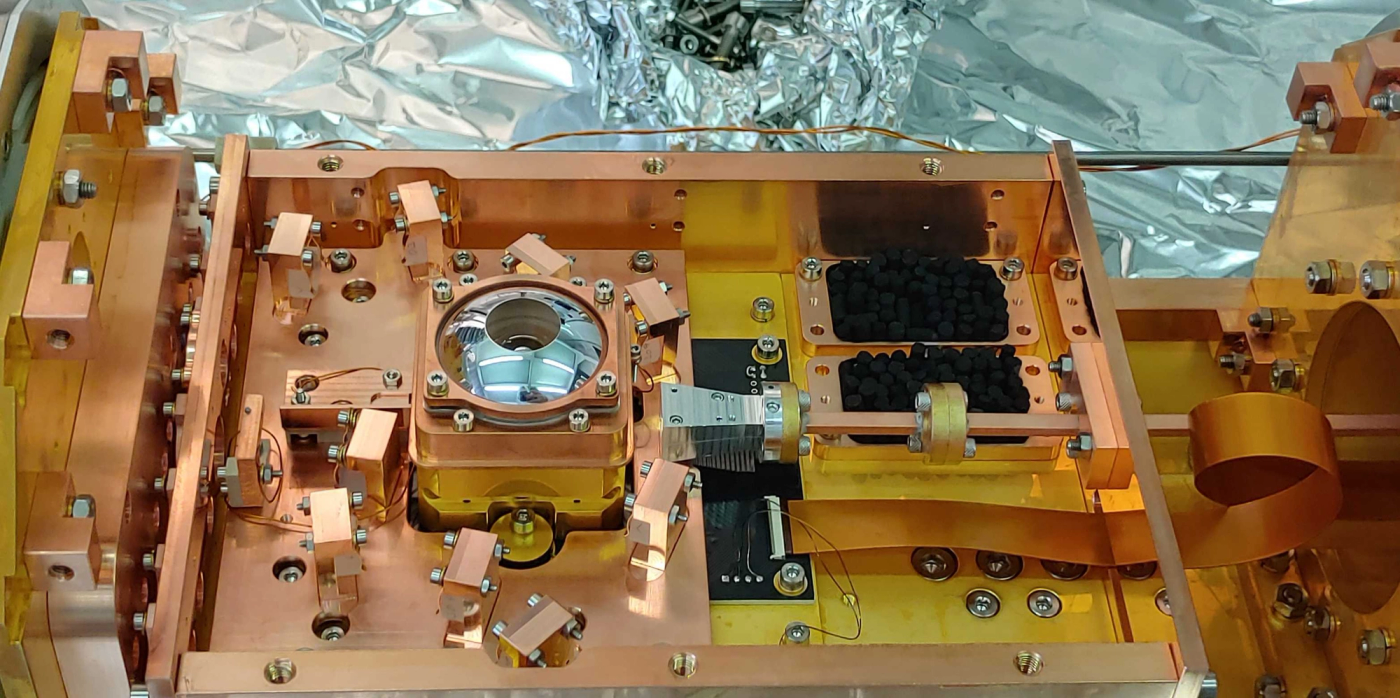
The full system consists of an electrode-patterned chip inside a vacuum chamber, placed inside a superconducting magnet, with lasers above it to read and control the atoms’ quantum states.
No flickering field. No forced single file. No junctions—because there are no fixed lanes to connect.
Why this matters?
There are two reasons this could be important, and neither depends on ZuriQ having the highest qubit count today.
The scaling math changes
A line with ten positions holds ten atoms. Capacity increases one position at a time. A 10-by-10 grid holds 100 atoms. A 100-by-100 grid holds 10,000, without requiring the chip to become dramatically larger.
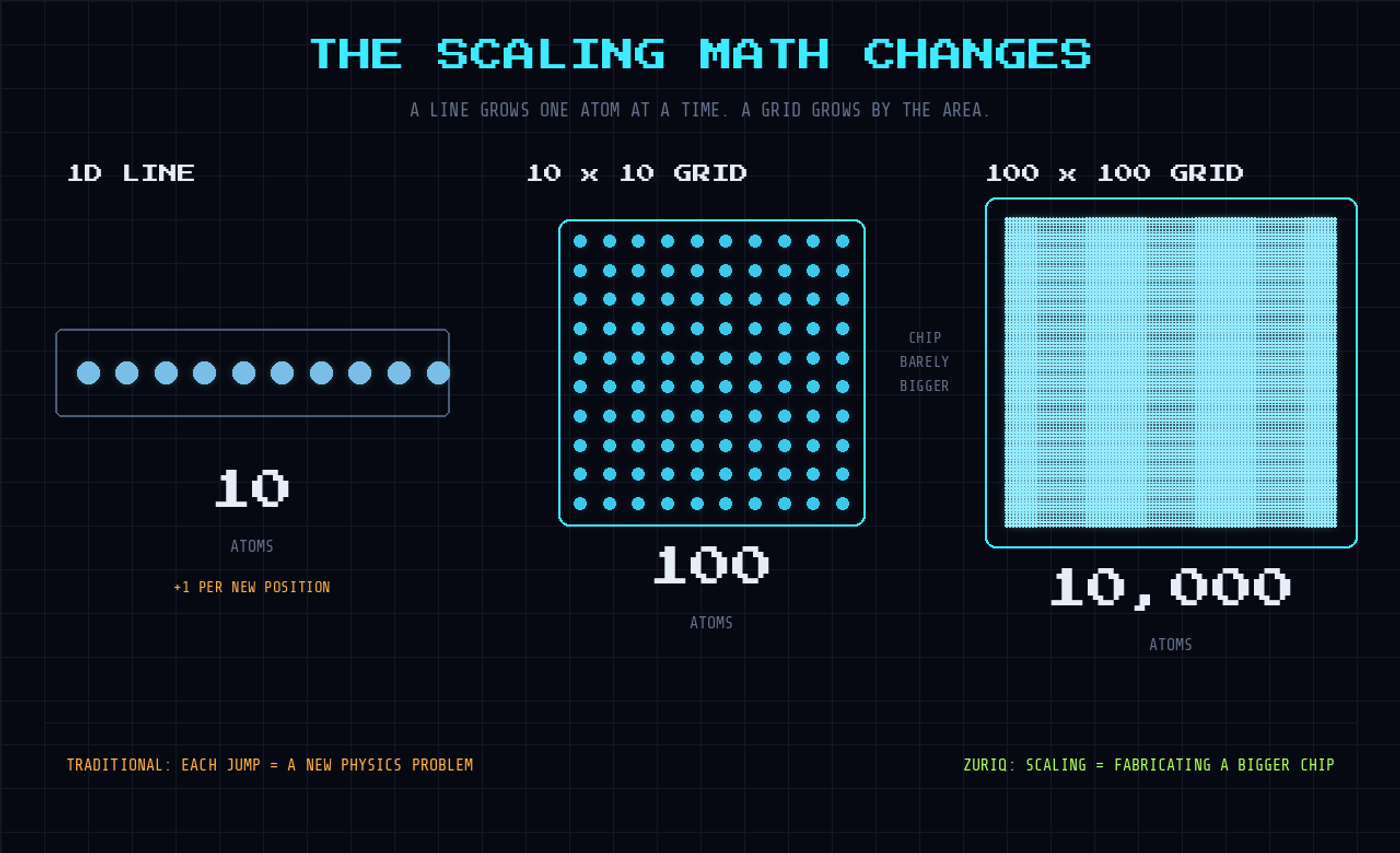
Under the traditional approach, each major increase in size creates another physics and engineering problem. Under ZuriQ’s approach, scaling may become more like fabricating a larger chip—a problem the semiconductor industry has spent decades learning how to solve.
The atoms can connect more directly
On a line, two atoms that are far apart may need to be moved past every atom between them before they can interact. That takes time and creates more opportunities for errors. On a free two-dimensional surface, one atom can move directly next to another.
That matters because useful quantum computing will eventually depend on error correction: combining many imperfect physical qubits to create a smaller number of reliable logical qubits. Trapped ions already produce some of the best error-correction results in the industry, and better connectivity could make that advantage stronger.
This is not only a slide-deck claim. ZuriQ has demonstrated nine individually trapped calcium ions in a native 3-by-3 grid on one chip—the largest array yet built using this specific architecture. The previous record was a single atom.
Its chips are also manufactured by Infineon, the German semiconductor company behind chips used in cars and bank cards. That means the design already runs through a real industrial manufacturing line rather than existing only inside a university cleanroom, where many novel chip architectures never make it any further.
Who is behind it, and what they have proved so far?
ZuriQ was founded by three researchers from Professor Jonathan Home’s trapped-ion group at ETH Zürich: Dr. Shreyans Jain, who co-authored the original architecture paper; Dr. Tobias Sägesser, now CTO, who built the early experimental systems; and Dr. Pavel Hrmo, now CEO, who brings more than a decade of trapped-ion experience from ETH Zürich and the University of Innsbruck.

Home remains a scientific adviser, so this is not a technology the founders licensed from somewhere else. They created it inside the lab where the underlying theory was developed.
The team has grown from four people to eighteen, including engineers from IonQ, Xanadu and Hamamatsu. In a field where relatively few people can actually build these systems, that movement of talent is a useful signal in itself.
The funding followed the technical progress. ZuriQ raised a $4.2 million pre-seed round in January 2025, when it had a published theory and one trapped ion. In July 2026, it raised a $25.5 million seed round led by Quantonation, with Forward.one, Extantia and Firgun Ventures joining. Every pre-seed investor returned.
That is roughly a sixfold increase in round size within eighteen months. Early investors reinvesting at a much larger round is one of the stronger private-market signals: they had the most access to the company’s progress and still chose to increase their exposure.
ZuriQ also published a peer-reviewed paper in Science Advances on 8 July 2026. The experiment used a single trapped ion as an extremely sensitive electric-field detector, capable of detecting a signal thousands of times weaker than a mobile phone’s field from several kilometres away.
It is not a commercial product, but it supports the company’s claim that it can measure and eventually correct the electrical noise that becomes more important as the system scales.
What still needs to be proven
The architecture is promising, but the hardest questions are still open.
Accuracy at scale is unproven. Quantinuum’s Helios records fewer than one error per thousand two-qubit operations. ZuriQ has not yet published comparable error rates. The 3-by-3 grid proves that the geometry works, but not that it stays accurate once the grid becomes crowded.
Nine becoming hundreds is the real test. More ions on one surface create more chances for interference, heating and control problems. The laser system also becomes harder to manage as the grid grows.
The competition is moving too. IonQ and Quantinuum are not standing still. If either develops a working two-dimensional architecture before ZuriQ demonstrates competitive accuracy, ZuriQ’s early lead could shrink quickly.
Still, the timing is interesting. Quantum computing attracted $12.6 billion in private investment in 2025, more than six times the amount raised in 2024.
Investors are no longer only asking whether quantum computing will matter. They are asking which architecture has the best chance of reaching useful scale.
ZuriQ’s entire bet is that the honest answer is still wide open.