
The Next AI Winners Won’t Be the Most Complicated Ones
Not the loudest technology. Not necessarily the most technically insane breakthrough. But the products that make AI feel usable, visual, guided, and almost stupidly easy.

Recently, I’ve been thinking about what will actually lead the next AI wave.
Not the loudest technology. Not necessarily the most technically insane breakthrough. But the products that make AI feel usable, visual, guided, and almost stupidly easy.
I’m currently working in digital transformation for a retail and consumer company, and honestly, it has made me realise how slowly transformation happens in the real world. A lot of workflows are still manual. Systems break every week. Data sits across different sales points. And the people using these tools range from college students to retail staff who have been in-store for 20 years.
They are great at their jobs. But many of them do not want to “learn AI.” They just want to get their work done.
That is why I think people are still stuck in the chatbot era. It makes sense: chatbots are easy. The interface is simple. You type, it answers. No technical skill needed. No complicated setup. No scary dashboard with 47 buttons and one mysterious API key waiting to ruin your day.
But the next phase of AI needs to go beyond chat
And here is the part most people get wrong. When a product feels this easy, people assume there is nothing underneath it. Easy must mean shallow. Simple must mean no moat. Just a pretty wrapper anyone could clone in a weekend.
I think that is exactly backwards.
For example, I built this blog with Lovable. A few years ago, building something similar would have required at least intermediate coding knowledge. Now, you can create a decent site by understanding the basic relationship between frontend, backend, database, and content storage — or honestly, if your needs are simple enough, you can just prompt and let Lovable do the rest.
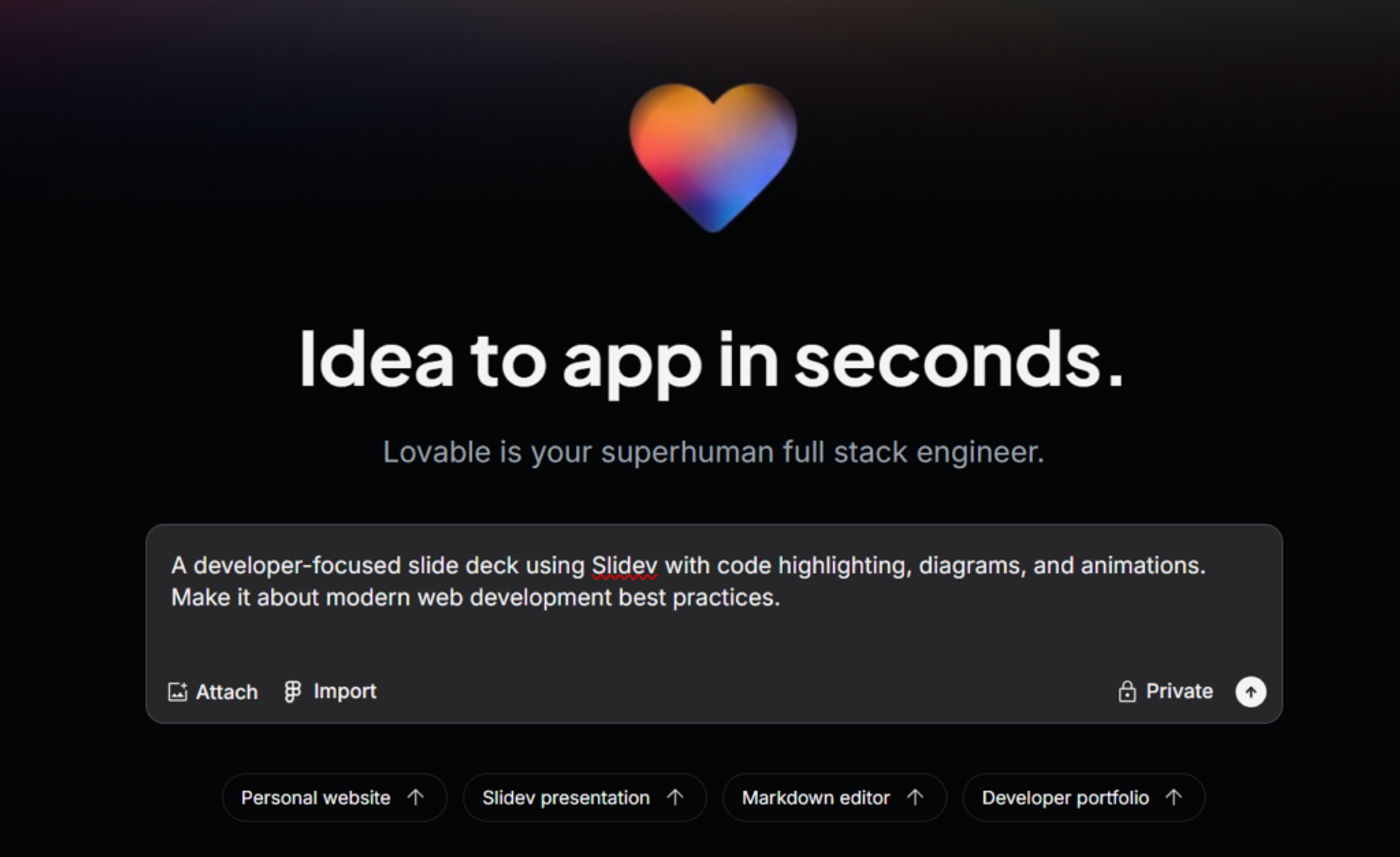
That is crazy.
But notice what actually happened there. Lovable did not remove the complexity. Code generation, infrastructure, deployment, hosting, error handling — all of it is still there. They just hid it from users. What reached us was a prompt box and a result. The hard part did not disappear. It went underground.
That, to me, is the whole game.
The real moats in AI are not going anywhere
- Proprietary workflow data
- Switching costs that quietly build up the longer you use something
- Distribution
- Network effects that get stronger with every user
Those things are real, and they are what actually make a business defensible.
But the winners are not the companies that show you their moat.
They are the companies that bury it. To the customer, the product just feels accessible, light, almost like a toy. Underneath, it is deeply integrated, sticky, and very hard to leave. The depth is real — it is just invisible.
So the magic trick is not making something simple. It is making something deeply complex feel stupidly simple, while quietly owning the layer that makes you impossible to rip out.
This is also why "easy" and "serious workflow software" are not opposites, even though they look like it. Real enterprise workflows are messy. Building around them properly is hard, unglamorous engineering. But the user should never feel that mess. The skill is absorbing the complexity on their behalf, so the experience that reaches them feels like: send prompt → get result → move on with your life.
Harvey is the version of this that actually has a moat. To a lawyer it looks almost too simple — ask in plain English, and it drafts, reviews, or digs out the risk hiding in a contract. But it is not just a chatbot with a law degree. Underneath sits the hard part: real legal-domain depth, airtight confidentiality, and tight integration into how a firm actually works — plus everything it learns from real legal workflows that a generic model never touches. The chat box is easy to copy. The depth, the trust, and the data are not. And once it is wired into a firm's day-to-day, leaving gets very expensive.

This is why I'm so interested in workflow automation and AI agents — but only if they are delivered properly. A good AI agent should not feel like adopting a second child. It should be stable, easy to use, low-maintenance, and designed around real workflows. And the better it is, the less of its own machinery you should ever have to see.
That is why Lovable became so popular. It turns a technically intimidating process into something playful and accessible — while the depth that keeps you there sits quietly underneath.
The test that separates winners from wrappers
If a product is only a clean surface with nothing underneath, it dies the moment a bigger platform ships the same feature for free. The ones that survive are the ones where the surface is easy but the underneath is owned — the data, the workflow, the switching cost.
Accessibility is what gets you adopted. The hidden moat is what lets you stay.
So my guess: the next AI winners won't be the smartest tools or the prettiest wrappers. They'll be the ones that own something genuinely hard to copy — and then make it feel effortless. Not the model builders. Not the surface-level wrappers. The workflow layer that hides its own depth so well that customers never realise how much they'd lose by leaving.
That is where I'd be looking.