Physical AI 101: Signals Behind the Robotics Mega-Rounds
Robotics mega-rounds are multiplying, but the real signal is not that humanoids are suddenly everywhere. Physical AI is scaling first in structured environments—and the quieter opportunity may sit in the infrastructure and post-deployment stack.
So recently, Robotics fundraising headlines are too loud for me to ignore.
Skild AI raised close to $1.4 billion to build a general-purpose “brain” for robots. Germany’s Neura Robotics reportedly secured commitments of up to $1.4 billion. Apptronik added another $520 million. These followed billion-dollar-scale financings for Figure AI, Physical Intelligence and other companies building the brains and bodies of Physical AI.
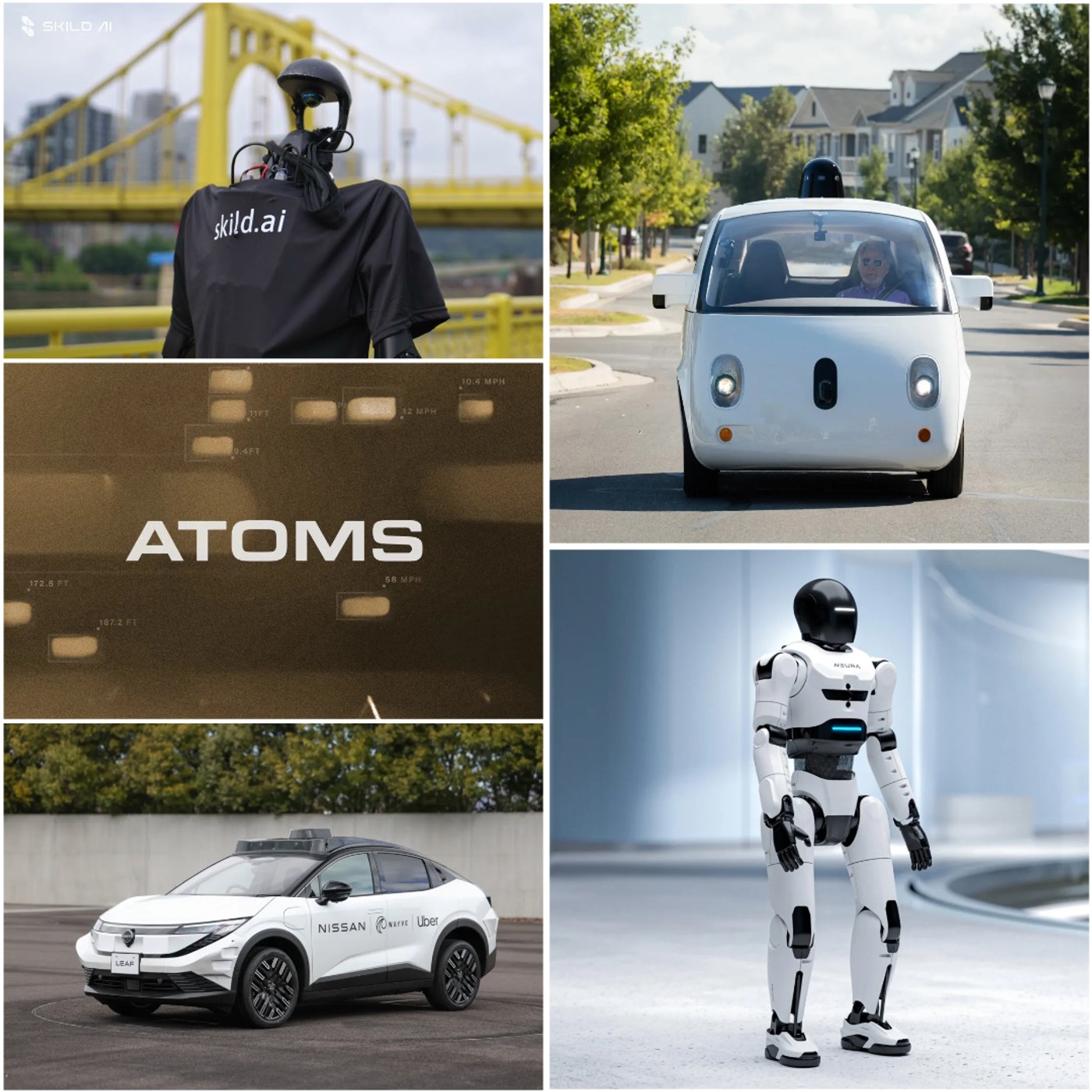
These are not prototype-sized checks anymore. Investors are increasingly financing production capacity, foundation models, data infrastructure and supply chains—not simply the next demonstration video.
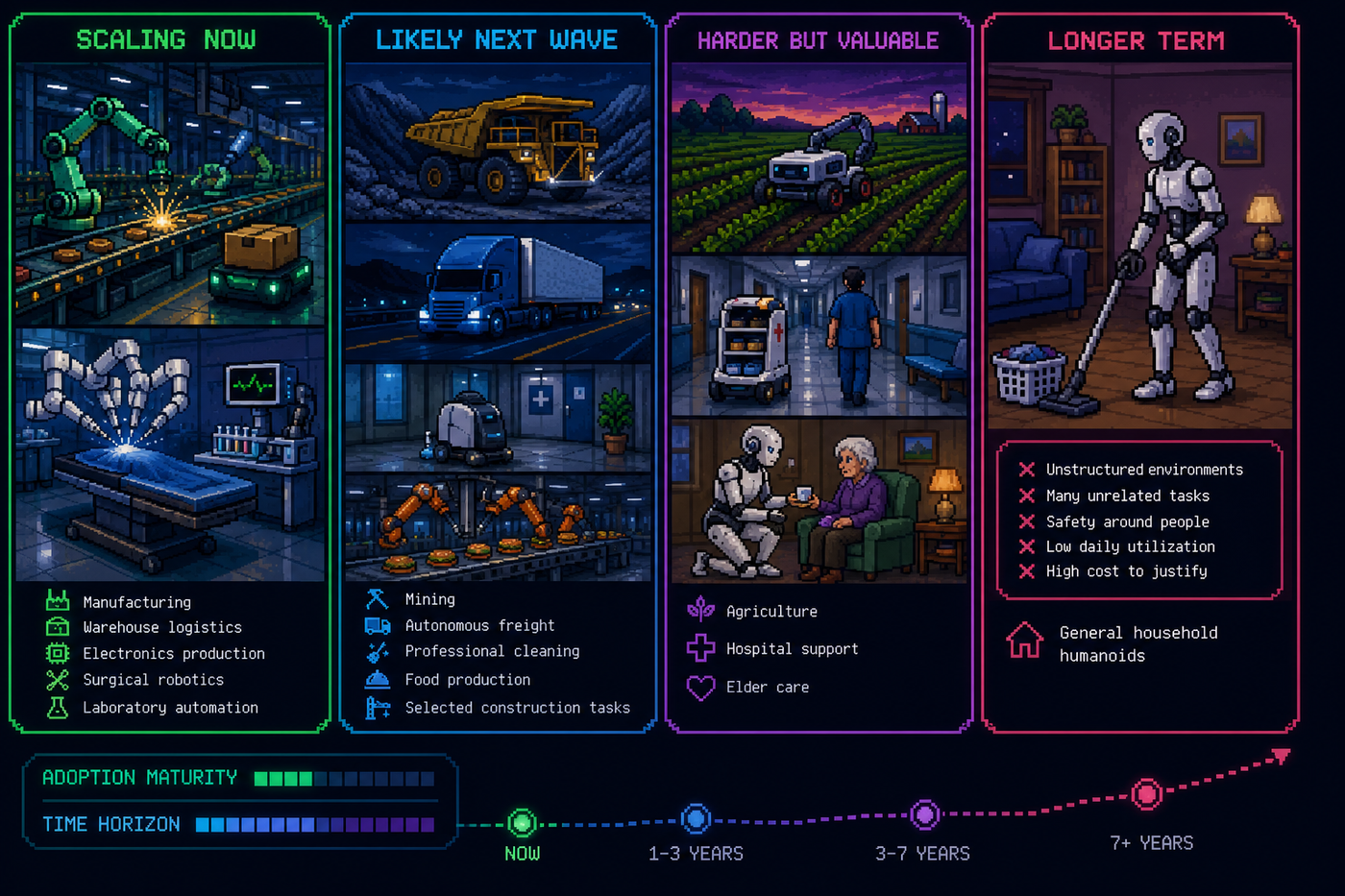
A useful conclusion is that Physical AI is moving from a research cycle into a deployment cycle.
But robots are not arriving everywhere at once.
They are scaling first where the physical world already behaves most like software.
Where robotics activity is concentrating in 2026
Reliable global deployment data is still surprisingly difficult to find. Company deployment figures are often self-reported, and the definition of a “deployed” robot can range from a commercial system working multiple shifts to a small pilot at a customer site.
268 disclosed funding announced from January 1 to July 24, 2026.
- Autonomous Mobility / Drones / Space
- Humanoid / Service / Robotics Infrastructure
- Industrial / Warehouse / Construction
- Healthcare & Life Sciences
- Agriculture & Environmental
To get a broader view of where activity is concentrating, I used my AI to scrape and map 268 robotic startups that disclosed funding between January 1 and July 24, 2026 (this is not sufficient but covered all the biggest rounds and strongest signals).
Company count tells a different story from the funding numbers above. It's a broader signal of where founders and investors are trying to deploy robotics — not a count of robots actually installed. A funded startup might still be at prototype stage or running an early pilot. But it does show where commercial experimentation is most active.
The largest category by company count is Humanoid, Service & Robotics Infrastructure — over a third of the entire dataset. That doesn't mean humanoids are the most widely deployed robots today: the category also captures foundation models, simulation, sensors, components, data pipelines and middleware. Its size says more about the stage the market is at — most of this activity is still building the underlying Physical AI stack, not deploying finished robots.
Industrial, Warehouse & Construction Robotics is the second-largest cluster, and the clearest application-focused one. Factories and warehouses are the easiest environments to automate first — repetitive workflows, measurable labour costs, and physical spaces that can be redesigned around machines rather than the other way round.
Autonomous Mobility, Drones & Space has far fewer companies, yet pulls in the most capital by a wide margin. That's a function of what the category actually costs to build: expensive hardware, extensive testing, heavy regulation, real manufacturing lines and, in some cases, financing entire operational fleets before a single dollar of revenue comes in.
Healthcare and Agriculture are the two smallest clusters (surprisingly, because I thought otherwise). The issue isn't opportunity, it's environment: both operate in specialised, harder-to-standardise settings, which slows deployment by nature. Hospitals need clinical validation and regulatory sign-off before anything gets near a patient. Farms vary by crop, terrain, weather and season, so a solution that works on one farm doesn't automatically work on the next.
Put together, the company map points to a clear pattern:
The broadest startup activity is forming around general-purpose robotic intelligence and the infrastructure underneath it, while the largest group of applied, deployment-ready companies is still targeting factories, warehouses and other controlled industrial environments.
Why some sectors are easier to automate
The key to any kind of automation is clear structure.
This is easy to see in software.
A software process is easiest to automate when the inputs are standardised, the workflow is clearly defined and the number of exceptions is limited.
Physical automation follows the same principle.
The difference is that software requires structure in data. Robots require structure in the physical environment.
| Software automation needs | Physical automation needs |
|---|---|
| Standardised data | Standardised objects and components |
| Defined workflow | Defined movement and task sequence |
| Consistent system behaviour | Consistent layouts, lighting and terrain |
| Clear exception handling | Detectable physical edge cases |
| System integrations | Connections to ERP, WMS and factory systems |
| Error logs and retries | Sensors, safe shutdown and human recovery |
Factories and warehouses are easier to automate because they are structured environments.
Components arrive in known positions, tasks follow repeatable sequences, and factors such as layout, lighting and safety zones can be controlled. The environment can be designed around the robot.
Homes, farms, streets and construction sites are far less predictable. Robots must handle clutter, uneven terrain, changing weather, moving people and countless rare edge cases. That is why a robot can weld a car body precisely but still struggle to fold mixed laundry in an unfamiliar home.
Structure is the strongest advantage, but several other forces accelerate adoption.
Labour shortages
Manufacturing, logistics, care, agriculture and construction all face shortages of available or skilled workers.
Japan’s ageing workforce helped make it an early robotics leader. Manufacturers in the United States and Europe are also struggling to recruit for repetitive, physically demanding and technically specialised roles. Automation becomes more attractive when positions remain unfilled and wages continue to rise.
Clear ROI
Robotics adoption is easier when the customer can measure the output.
A warehouse can calculate picks per hour. A manufacturer can measure cycle time, defects and downtime. A mine can calculate tonnes moved per truck.
High utilisation also matters. An expensive robot working across multiple shifts has a much clearer payback period than one used occasionally. Robot-as-a-Service models are further lowering the barrier by converting a large capital purchase into a recurring operating expense.
Safety
Mining, construction, freight and heavy manufacturing contain dangerous tasks where the value of automation is not limited to labour savings. Moving people away from hazardous environments can justify deployment even before the robot becomes cheaper than the worker it replaces.
Industry maturity
Manufacturing and automotive companies have spent decades building automation infrastructure, systems-integration expertise and maintenance teams.
A new robot still needs to be tested and integrated, but the customer does not need to create the entire operating environment from zero.
Better technology
Cheaper compute and sensors, stronger computer vision and new vision-language-action models are making robots more adaptable. They can increasingly learn from demonstrations and handle small variations rather than relying on every movement being manually programmed.
Technology expands the range of tasks robots can perform, but it does not remove the advantage of structure. It simply allows automation to spread further within structured environments.
Where these sectors could go next
Market forecasts vary enormously because research firms define robotics differently. Some include hardware only. Others include software, autonomous vehicles, drones, services or the economic value created by robotic labour.
The direction is more useful than the exact numerical forecasts I suppose.
The sceptical view I strongly side with
Rodney Brooks, the co-founder of iRobot, has argued that “we are in a humanoid robot bubble.”
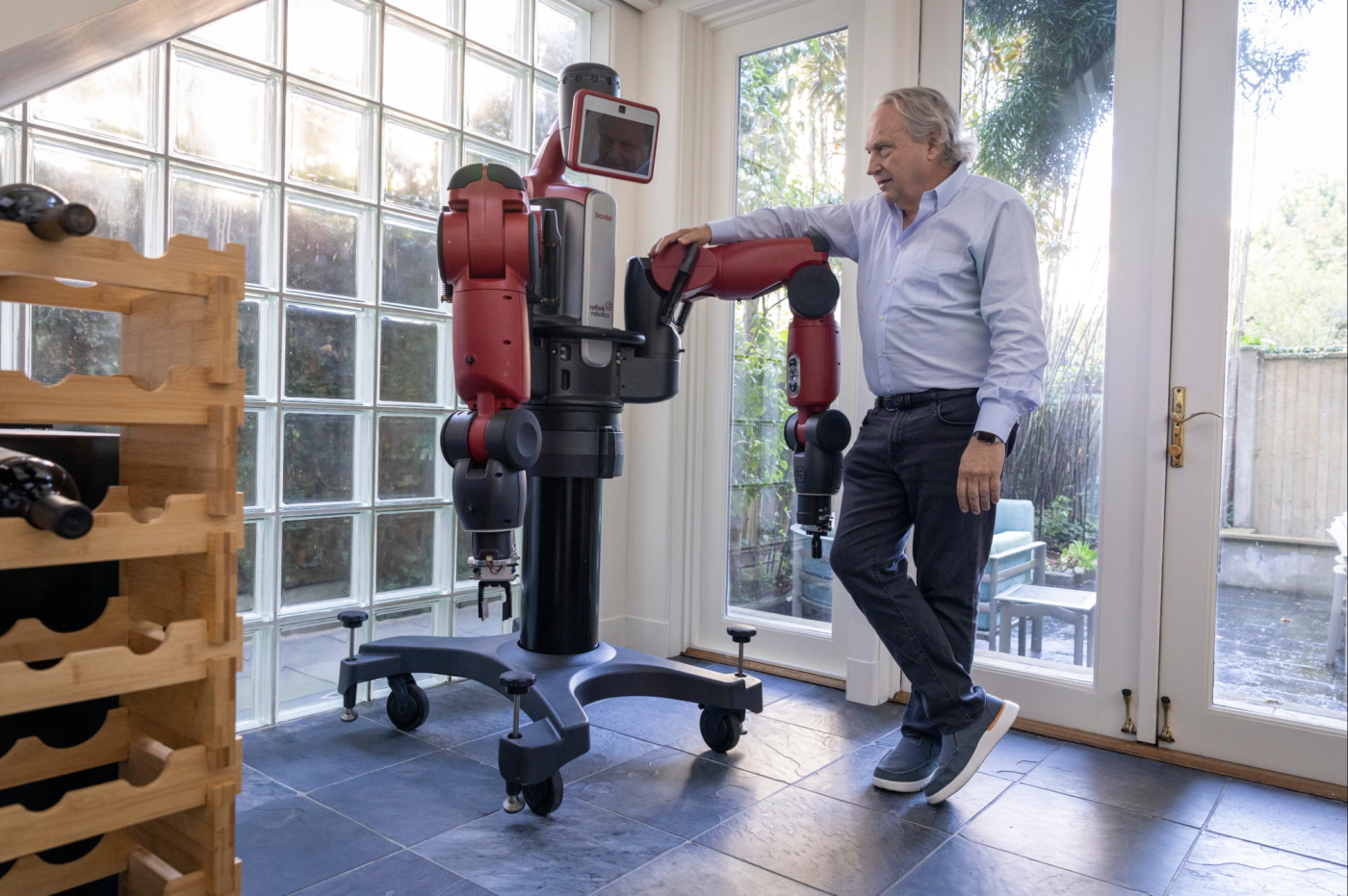
His main criticism is that the industry underestimates the difficulty of human manipulation: Humans do not rely on vision alone. Our hands contain thousands of specialised touch receptors that continuously detect force, texture, slip and deformation. A robot trained mainly through video imitation may understand what a movement looks like without understanding the physical feedback needed to perform it reliably.
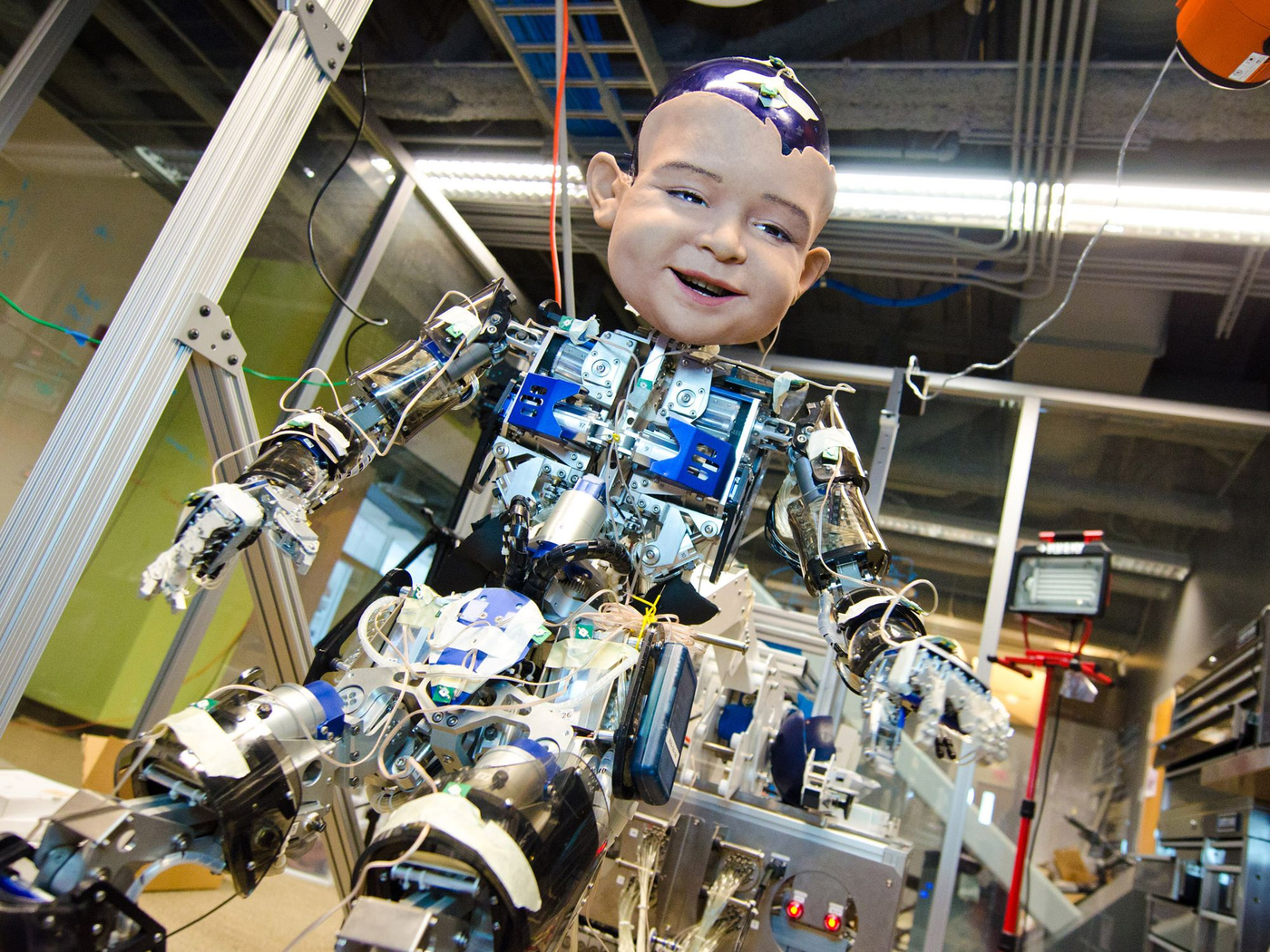
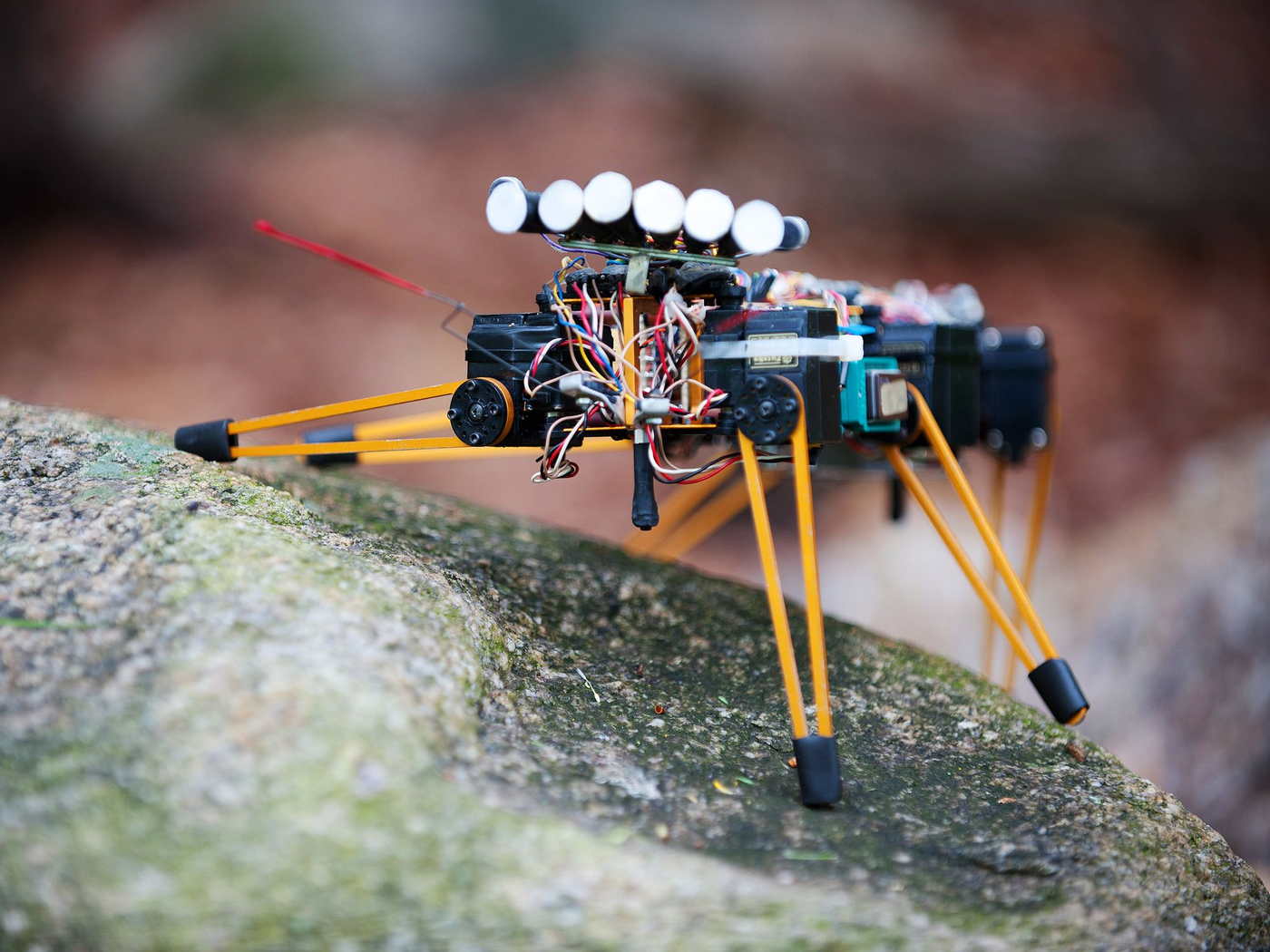
Brooks also expects many successful robots to move away from the strict human form. Wheels may be more efficient than legs. Multiple arms may be more useful than two. Specialised end-effectors may outperform human-like hands.
That does not mean humanoids will fail. Human-shaped robots have a real advantage: factories, tools, stairs and workplaces were already designed around the human body.
But the strongest evidence will not be another polished demonstration. It will be a robot performing multi-shift, paid work at a customer site, with limited teleoperation and a measurable return on investment.
For now, most verified Western humanoid deployments remain pilots or narrowly defined commercial programmes. Even bullish forecasts generally assume adoption will remain relatively slow until the mid-2030s.
Most of the capital flowed into companies building robots themselves, while post-deployment infrastructure attracted far less funding.
- Robots — Non-Humanoid
- Humanoid
- Infrastructure for Robots
- Infrastructure for Deployment
The upstream infrastructure layer
A commercially useful robot depends on much more than the company whose name appears on its body. Upstream sits the infrastructure layer: the brains, senses and skeleton from which robots are built.
Compute and vision are already receiving significant investment. But tactile sensing, actuators and dexterous hands remain difficult bottlenecks.
A robot may correctly recognise an object but still fail to understand how firmly to hold it, whether it is slipping or how the material will deform.
Robotics also lacks the internet-scale training data available to language models.
Physical interaction data must be created through simulation, human demonstrations, teleoperation and real deployments. That makes data collection and evaluation an infrastructure category in its own right.
The brains, senses and mechanical systems from which robots are built.
▣ Compute and edge AI
▣ Simulation and digital twins
▣ Foundation models
▣ Middleware and operating systems
▣ Vision and LiDAR
▣ Tactile sensing
▣ Actuators and dexterous hands
▣ Data and teleoperation
The downstream post-deployment layer
Once a robot is installed, a second layer becomes necessary.
This is the less glamorous, more operationally essential part of the market which I believe holds more of the opportunities: keeping robots running, safe and integrated after deployment.
A customer rarely wants a robot by itself. It wants an operating workflow.
The machine must receive orders, understand inventory, coordinate with other equipment, report problems, recover from failures and satisfy safety and cybersecurity requirements.
Experimenting with one robot may be an innovation project.
Operating 500 robots requires fleet software, service-level agreements, maintenance, insurance, security and financing.
The operating stack required to keep robots coordinated, safe, integrated and financeable once they are live.
▣ Fleet management and orchestration
▣ Predictive maintenance
▣ Remote assistance
▣ Enterprise integration
▣ Cybersecurity
▣ Safety and certification
▣ Insurance and liability
▣ RaaS and financing
The signal behind the mega-rounds
The recent mega-rounds do not prove that humanoid robots are ready to replace broad categories of human labour. They show that investors believe Physical AI is important enough to finance at industrial scale.
The over 200 funded companies in YTD 2026 show where that belief is concentrating.
The largest group is building humanoids, service robots and the infrastructure beneath them. The largest application-focused group is targeting industrial, warehouse and construction workflows. The largest disclosed checks are flowing into capital-intensive autonomous mobility, drones and space systems.
Capital is betting on generality. Customers are still buying structure, reliability and measurable ROI.
However, the quieter opportunity may lie in the infrastructure that gets robots into the workplace—and the operating stack that keeps them working once they arrive. I believe demands for this layer stands strong given Robotics is moving deeper towards deployment within the next decade.
Note: Check out this super cool site if you want to browse some illustrations of different robotic models. One of my favorite site ever :D