
Omnigent: Databricks Just Built the Control Tower for AI Agents
Databricks’ Omnigent is not another AI agent. It is a control layer for managing many agents at once — a signal that the next AI infrastructure battle may be about orchestration, governance, and enterprise trust.
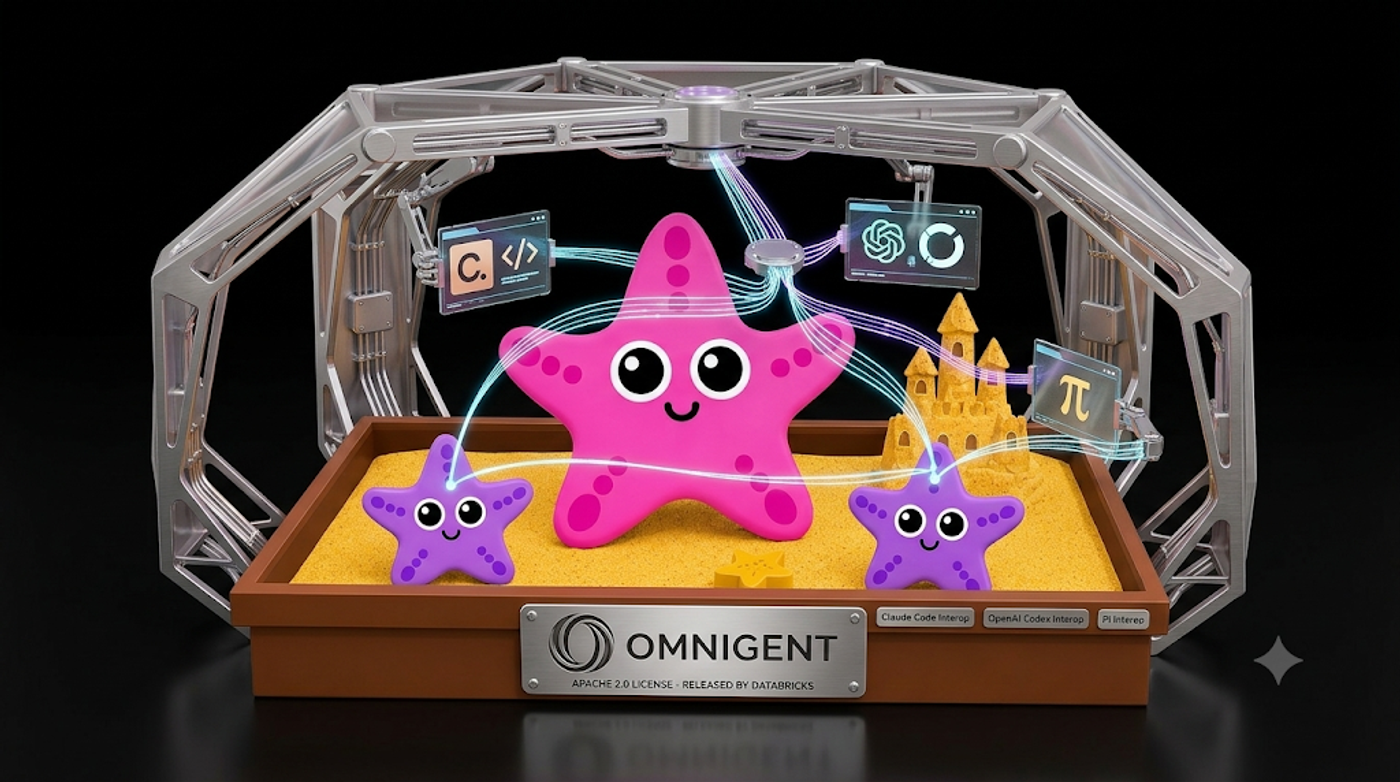
If you have used AI tools lately, you might recognise the mess.
Claude Code is open in one window. Codex is open in another. Cursor is helping with something else. Maybe a search agent is running in the background. You copy one output into another tool, paste something into Slack, then rewrite the final version in a doc.
Each tool is clever.
Together, they are chaos.
That is the problem Databricks is trying to solve with Omnigent.
The easiest way to understand it is this:
Omnigent is a control tower for AI agents.
It is not another chatbot. It is not trying to be the smartest model. It is a layer that sits above different AI agents and helps companies coordinate, control, share, and swap them.
That matters because the AI industry is moving from:
Can an agent do something impressive?
to:
Can a company actually manage hundreds of agent tasks safely?
Omnigent is Databricks’ answer to that second question.
1. What Omnigent actually is
To understand Omnigent, you only need three words: model, harness, and meta-harness.
A model is the brain. GPT, Claude, Gemini, Llama — these are models. On their own, they mostly generate text.
A harness is the wrapper that gives the model tools. It lets the model read files, write code, search, run commands, or interact with a workspace. Claude Code, Codex, and Cursor are examples of harnesses.
A meta-harness sits one level above those harnesses. It manages multiple agent tools at once.
That is what Omnigent is. Omnigent is the management layer above AI agent tools.
A simple analogy:
The model is the brain.
The harness gives the brain hands.
Omnigent is the manager coordinating the team.
That is the whole idea.
Databricks is not saying every company should use one agent for everything. It is saying companies will use many agents, and those agents need a shared management layer.
2. Why businesses need this
For an individual developer, using multiple AI tools is annoying but manageable.
For a business, it becomes a serious problem.
Different agents may have different permissions, different cost structures, different logs, different security rules, and different workspaces. One agent may write code. Another may review it. Another may search documentation. Another may update internal systems.
That creates a new management problem:
Who controls what these agents are allowed to do?
A company cannot simply unleash autonomous agents into real workflows and hope they behave. It needs cost limits, approvals, access control, audit logs, secret handling, and collaboration.
That is where Omnigent becomes useful.
Why companies need an agent control layer
| Business problem | Why it matters | How Omnigent helps |
|---|---|---|
| Too many agent tools | Teams use different tools that do not talk to each other | Creates one coordination layer |
| Vendor lock-in | The best model or harness changes quickly | Makes agents easier to swap |
| Security risk | Agents may access tools, files, or secrets | Adds rules, approvals, and secret handling |
| Cost risk | Long agent runs can become expensive | Adds spending limits and checkpoints |
| Lack of visibility | Agent work happens inside one person’s terminal | Creates shareable sessions |
| Enterprise approval | Security and finance teams need governance | Adds logs, access control, and auditability |
The business value is not “cool AI.”
The business value is making AI agents usable inside real companies.
That means turning agents from experiments into infrastructure.
3. How Omnigent works
Databricks describes Omnigent around three ideas: compose, control, collaborate.
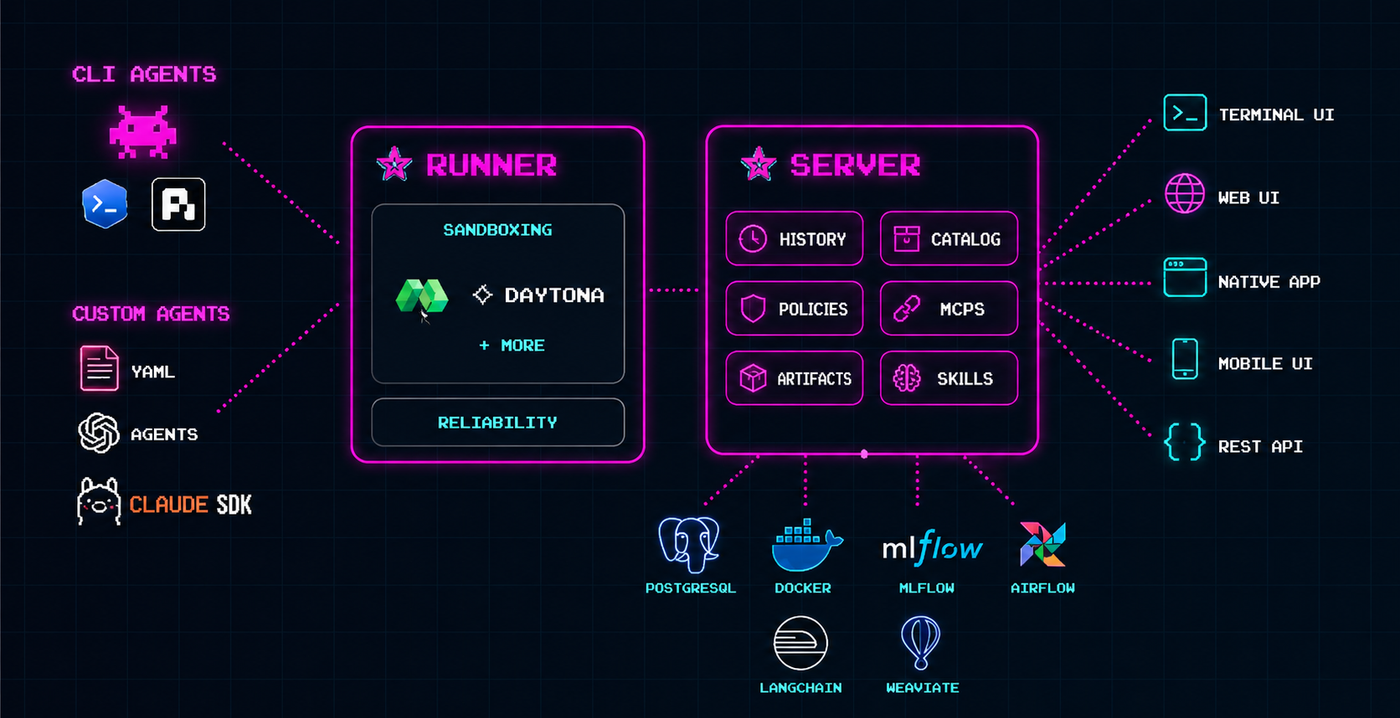
That framework is useful because it explains the product without too much technical language.
Compose means a company can mix and match agents. If one agent is better for writing code and another is better for review, the company can use both. If a better model appears next month, the company should not need to rebuild the whole workflow.
Control is the most important part. Omnigent lets companies enforce rules outside the agent. That matters because prompt-based rules are weak. Telling an AI “please don’t do anything risky” is not the same as blocking risky actions in software.
A business could set rules like:
- pause when the task reaches a spending limit
- require human approval before publishing code
- hide secrets from the agent until an action is approved
- log every step of the agent session
- limit which files or tools the agent can access
Collaborate means agent sessions can become shared workspaces. Instead of an agent working invisibly in one person’s terminal, teammates can open a link, watch what happened, comment, and step in.
That sounds simple, but it matters.
Google Docs made writing collaborative. GitHub made code review collaborative. Figma made design collaborative.
Omnigent is trying to make agent work collaborative.
The clever design idea is that different agent harnesses may look very different inside, but they often look similar from the outside.
Messages and files go in.
Results come out.
Databricks saw that pattern and built a shared layer around it. That is why Omnigent can sit above different harnesses instead of forcing a company to manage every tool separately.
In plain English:
Omnigent makes different agent tools plug into one management layer.
4. Why Databricks released this
Databricks is not trying to win the AI market by building the single best frontier model. Databricks’ strength is data, governance, enterprise trust, and infrastructure. These are boring words, but they are exactly what big companies care about when AI moves from demo to production.
Omnigent fits that strategy perfectly. It is model-agnostic. It can sit above OpenAI, Anthropic, Google, Meta, Mistral, or whatever model comes next. Databricks does not need to pick the winning model if it can own the layer that manages model usage.
That is the strategic move:
If you cannot control the model layer, control the layer above it.
Open-sourcing Omnigent is also important. This is not just generosity. It is distribution. Databricks has used this kind of playbook before: give the core technology away, get developers and companies to build around it, then sell the managed enterprise version to customers who want security, reliability, billing, support, and scale.
Free is not the absence of a business model. Free is the customer acquisition strategy. Three signals stand out.
First, model-agnostic strategy. Databricks does not need the best model if Omnigent works across models and agents. The strategic read is that Databricks wants to own the coordination layer.
Second, open-source land-grab. Giving the core away helps developers adopt the architecture early. The strategic read is that Databricks can later monetize the managed enterprise version.
Third, enterprise trust wedge. Omnigent focuses on rules, logs, security, and billing. That fits Databricks’ existing customer base and turns agent chaos into enterprise infrastructure.
5. The Venture Take
Omnigent matters because it shows where enterprise AI is going.
The first phase of AI was about smarter models. The next phase is about making those models manageable.
That means orchestration, governance, cost control, auditability, collaboration, and security. Not as nice-to-have features, but as the infrastructure layer that lets companies actually use AI agents in production.
For AI infrastructure startups, this is both validation and warning.
It validates the market because Databricks is effectively saying:
Agent infrastructure is important enough for us to open-source a product around it.
But it is also a warning.
If a startup is building a thin, generic agent orchestration layer, Omnigent makes the “is this a company or a feature?” question much sharper. A trusted enterprise incumbent has now released a free tool that touches orchestration, control, collaboration, and agent management.
That does not mean startups are doomed.
It means they need to be deeper.
I personally believe the winners will need a sharper wedge, such as:
- agent security for financial institutions
- compliance workflows for healthcare or insurance
- evaluation infrastructure for high-risk agent actions
- permission-aware RAG for messy enterprise data
- cost optimization for large-scale AI workloads
- testing environments for agentic software deployment
The generic layer may get crowded quickly. The deep workflow layer is still wide open. That is the real signal from Omnigent.
Update: I tested Omnigent from a Windows machine, and the setup was not smooth. Ollama and a local Qwen model worked fine, but Omnigent’s local server and agent workflow hit several Unix-style dependency issues on native Windows, including missing termios, tmux, and Python’s resource module. WSL Ubuntu appears to be the better route for now. My read: Omnigent is interesting infrastructure, but still early and more suitable for developers comfortable with Linux-style environments than for casual Windows-based testing.