
Gradium: Free Recipe, Paid Kitchen
Gradium just raised $100m to sell a technology it already open-sourced. Is that genius, or a warning sign?
On 9 July 2026, a Paris startup called Gradium announced it had topped up its seed round to $100m, with chip giant NVIDIA jumping in as a new backer. Gradium is seven months old, no disclosed valuation yet. The first $70m landed back in December 2025, led by FirstMark Capital and Eurazeo, with French telecom billionaire Xavier Niel, shipping magnate Rodolphe Saadé, and former Google CEO Eric Schmidt as backers.
Big numbers, famous names. The interesting stuff is underneath.
So what does Gradium actually build?
Gradium makes AI voices — the tech behind things like customer service bots that can talk to you, or apps that read text out loud in a realistic voice. Think ElevenLabs, if that name rings a bell. Same category.
It's a SaaS business at its core: cloud-hosted, credit-metered, subscription tiers running from a free plan up to custom enterprise pricing. But unlike most SaaS companies, the same underlying model can also be deployed on a company's own servers, or run directly on a device with no internet connection at all — same model, everywhere. That flexibility sounds like a footnote, but it's actually the most defensible thing about the company, and we'll come back to it.
Here's the technical twist that makes them different. Most voice AI today works like a relay race: one AI listens and turns your speech into text, a second AI (the "brain," usually a chatbot model) figures out a reply, and a third AI turns that reply back into speech. Three separate runners, three handoffs, three chances to fumble the baton — which is exactly why voice assistants sometimes have that awkward, laggy pause before they answer you.
Gradium trains one single model to do all of that at once — listening, understanding, and speaking together, no handoffs. Faster, more natural, less clunky. That's the whole pitch.
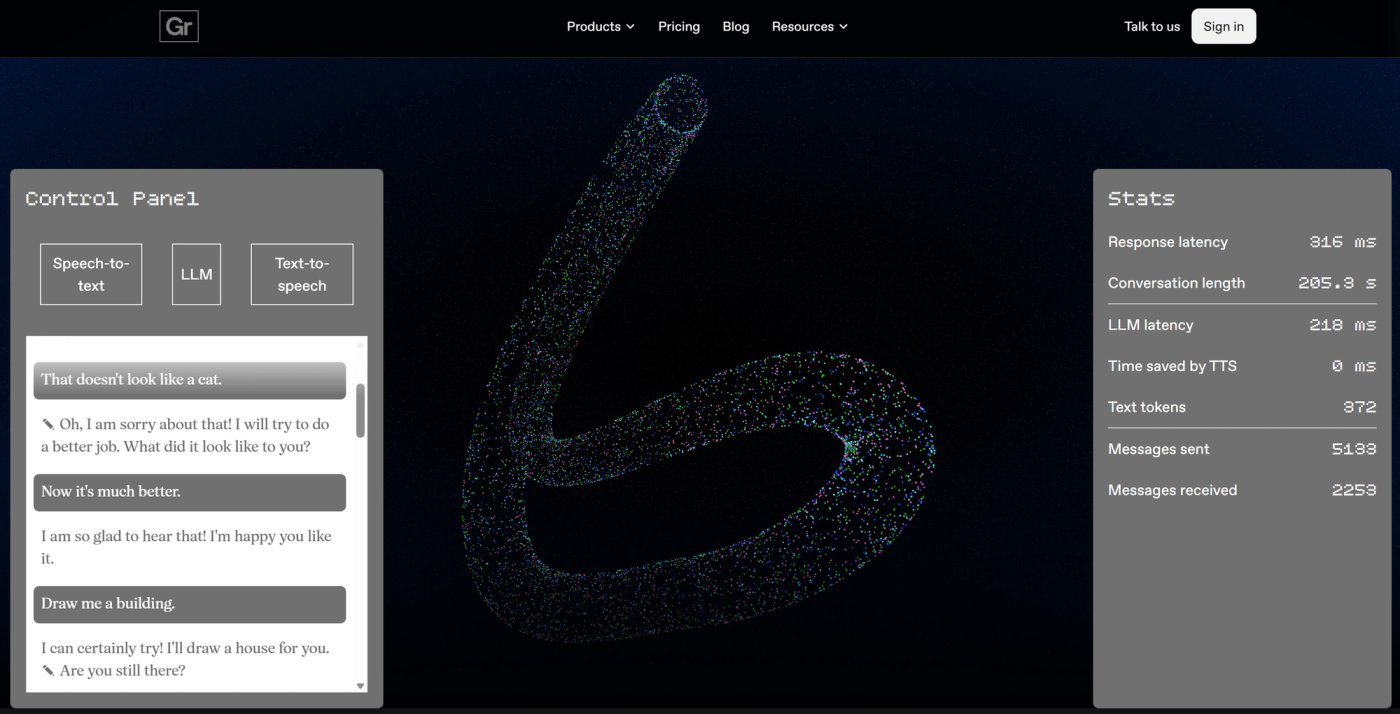
They also give away Gradbot, an open-source framework that lets a developer build a working voice agent in about 50 lines of code. The framework itself costs nothing. But it doesn't do any of the actual voice work on its own — it's just the traffic controller coordinating three streams (listening, thinking, speaking) in real time. The listening and speaking parts run on Gradium's paid API underneath, so every second of speech Gradbot processes draws down credits from whichever Gradium plan you're on. Gradium's own documentation is refreshingly candid about where the free layer stops:
Gradbot is built for prototyping. For production, use Gradium APIs.
Give away the tool that gets developers hooked, meter the ingredient it actually runs on.
One limit worth remembering: it currently speaks five languages — English, French, German, Spanish, Portuguese. Hold onto that number.
Their edge — and why it might not last
This isn't a team that learned voice AI from a course. The four co-founders — previously at Google Brain, DeepMind, and Meta — literally co-authored the research papers (EnCodec, SoundStream, Moshi) that much of today's voice AI industry, including several competitors, is now built on. Before starting Gradium, they ran Kyutai, a non-profit lab in Paris, and in 2024 Kyutai showed off the first AI model that could hold a real back-and-forth conversation — interrupting, being interrupted, talking naturally, ahead of OpenAI's similar demo. Then Kyutai gave the whole thing away, fully open-source.

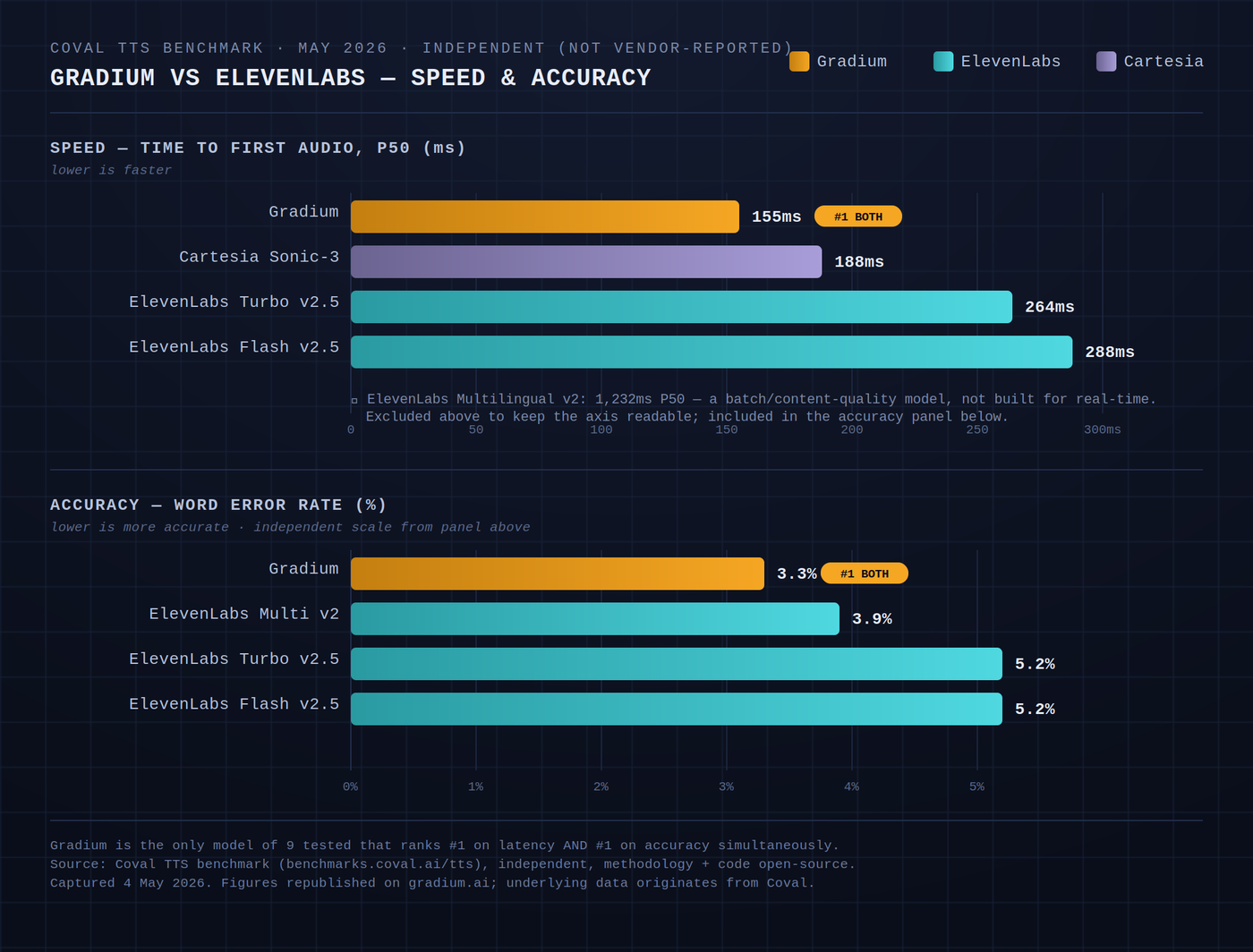
That decision is the hinge of the whole story. On independent speed-and-accuracy tests, Gradium currently leads on response time, latency consistency, and transcription accuracy all at once — nobody else on the leaderboard manages all three simultaneously. They also claim to be 3-4x cheaper than ElevenLabs, though that number is self-reported and worth treating as "plausible, unverified."
Here's the catch. The core technique that makes Gradium fast — one unified model instead of three — isn't a secret they're sitting on. It's already the industry's preferred approach, partly because Gradium's own founders published it while they were still running Kyutai. Their tech is now the foundation underneath NVIDIA's own voice product and a Chinese competitor's model. So today, Gradium is genuinely the best at execution. But they don't own the underlying idea — nobody does, because they gave it away. When everyone has access to the same recipe, the advantage from being first tends to shrink fast.
Gradium vs. ElevenLabs: not the same fight
It's tempting to read this as a straight rematch — same product, different team. It's not quite that.
ElevenLabs has grown into something much bigger than a voice API: customer service agents, AI-narrated audiobooks (a Spotify deal targeting $100m in audiobook revenue alone), dubbing tools, music generation, even government contracts. Estimated revenue around $500m a year, valued at $11 billion in its last round. That's not a startup anymore — that's a real business with real distribution.
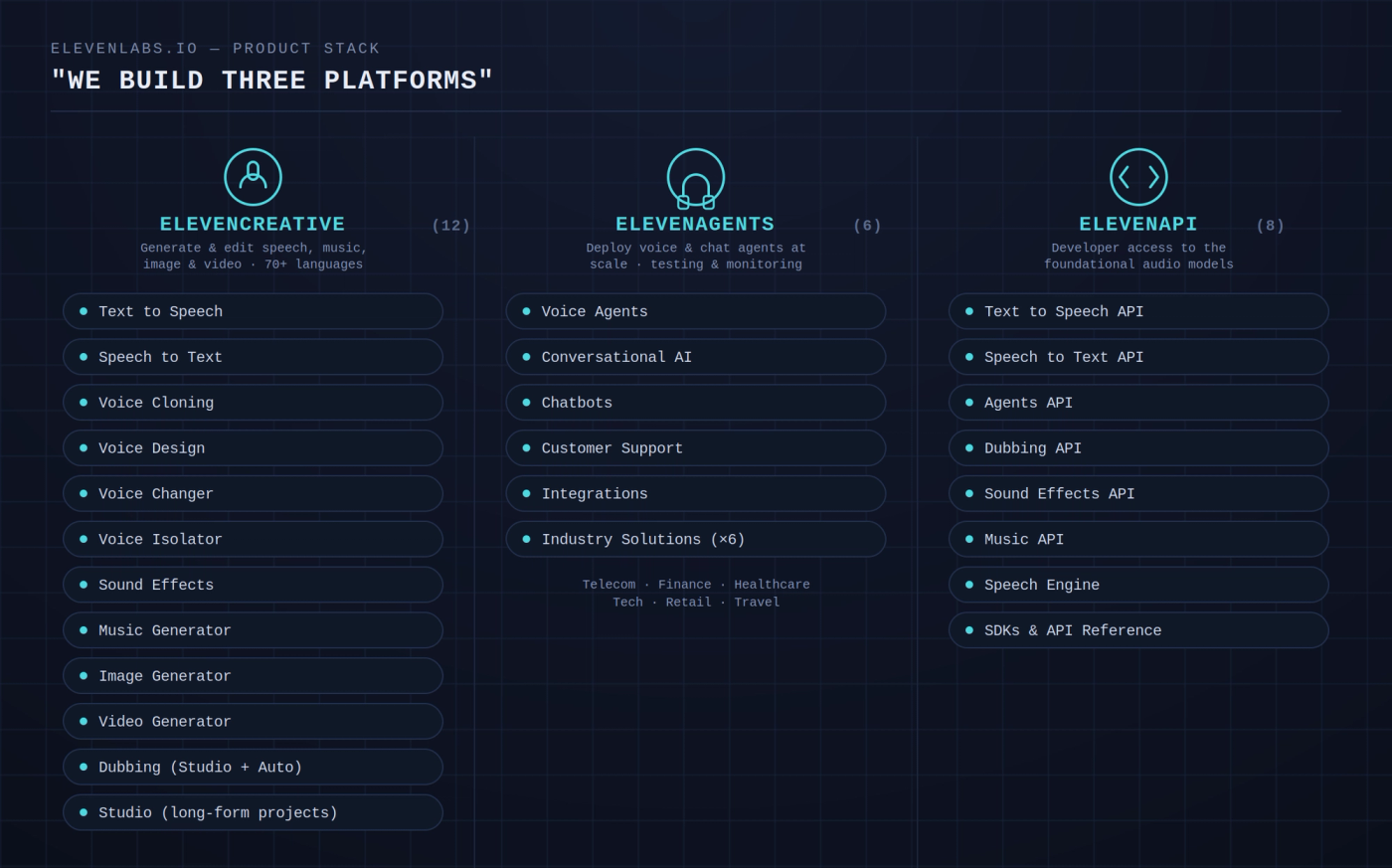
Gradium has none of that extra layer. No music tool, no audiobook business, no dubbing studio. Just the core voice engine, sold on speed and price.
But the one place they do go head-to-head — live voice agents answering customer calls — is exactly where ElevenLabs is currently winning the most business. It already powers voice support for Revolut (millions of customers, 8x faster problem resolution) and Klarna (35 million US customers). So in the one arena where these two companies actually compete, Gradium is showing up with a better stopwatch time, while ElevenLabs is showing up with the customer relationships already locked in.
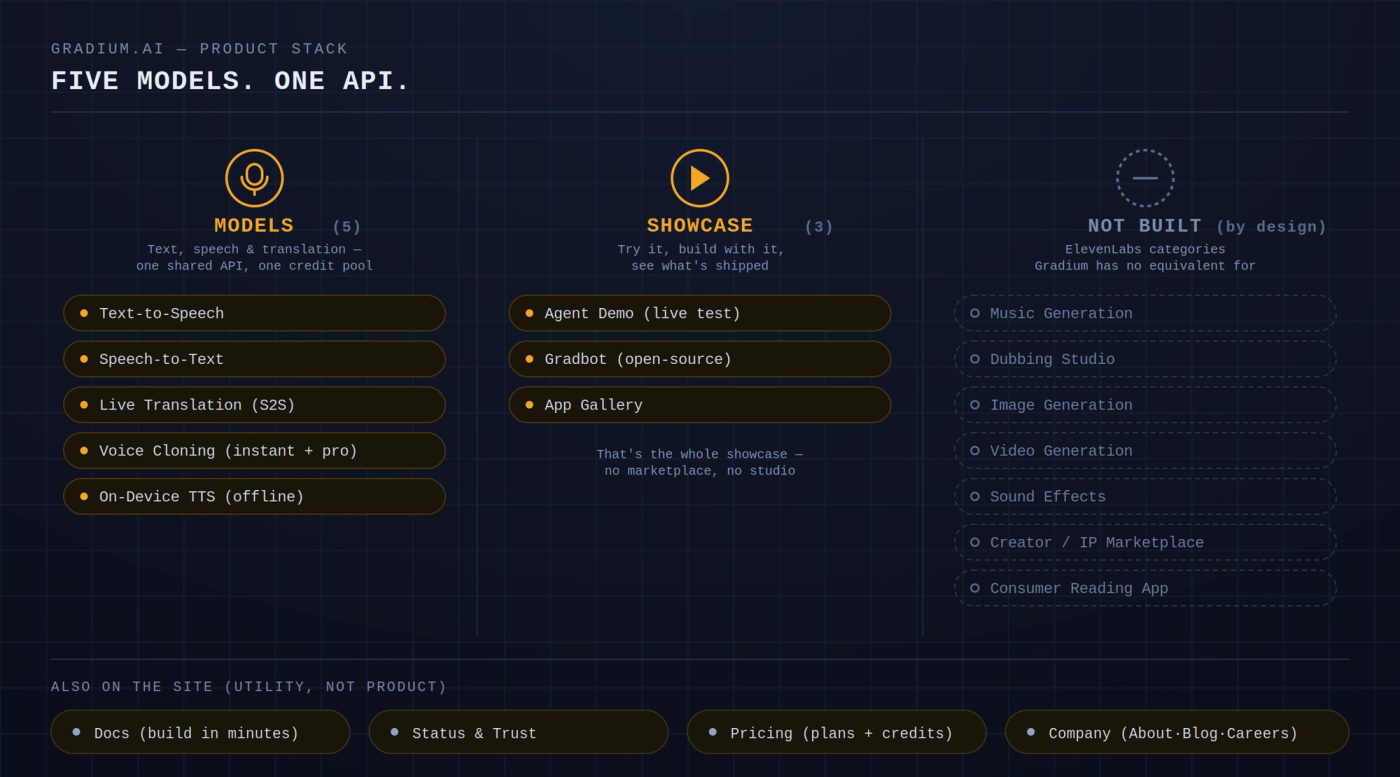
Gradium wins the test. ElevenLabs already has the client. And that five-languages-versus-32-to-70-languages gap is a real dealbreaker for any company trying to serve customers globally, not a minor footnote.
The takeaway
The real question isn't who's fastest this quarter — speed records get broken constantly. It's whether Gradium's deployment flexibility (cloud, on-prem, fully offline, same model everywhere) is a moat that's actually hard to copy, or just a nice feature that gets matched eventually. That flexibility is why sovereignty-sensitive buyers like Renault sign on for in-car voice AI, where the model needs to work without a live connection. It's the strongest thing Gradium has that ElevenLabs' cloud-first platform can't easily answer.
But this company raises a bigger question. Even the people who invented the model cannot stop others from copying the idea once the research is published. That suggests having the best AI model may not be a lasting advantage. Good ideas spread quickly, so the real competitive edge may come from somewhere else: distribution, customer trust, or, in Gradium’s case, the ability to run anywhere.
$100m in seed funding is a lot of capital riding on which answer turns out to be true.