
AI Governance and the Bullet Some Startups Will Dodge
A Silicon Valley insider just broke ranks. Here's what AI governance actually means, why the industry is spending nine figures to suppress the debate, and which startups come out alive when the rules arrive.

What AI governance actually means, why Silicon Valley is fighting over it, and which companies come out alive.
The thing that will shape AI companies most over the next decade isn't a model release or a funding round. It's a fight in legislatures and op-ed pages over a deceptively boring phrase: AI governance.
This week, that fight got personal for Silicon Valley.
What "AI governance" actually means
Strip away the jargon and it's one question:
Who decides how this technology is allowed to behave — and how do we hold them to it?
The questions on the table
That single question fans out into a lot of practical ones:
| Question | Who it affects |
|---|---|
| Can AI be used in hiring or lending decisions? | Banks, employers, fintech |
| Does AI-generated content have to be labelled? | Media, social platforms, advertisers |
| Who's liable when an AI system causes harm? | Every AI product company |
| What data can a model be trained on? | Frontier labs, publishers, artists |
| Are children protected from engagement-maximising AI? | Consumer AI, edtech, social apps |
Each one of these is a line that either constrains or unleashes a business model. That's why the politics have turned ugly.
The controversy: a playbook borrowed from crypto
The insider who broke ranks
John O'Farrell — the first outside partner ever hired at Andreessen Horowitz, a Silicon Valley insider for four decades — just published an essay in The New York Times calling out his own former colleagues.
His charge: the most powerful players in AI have raised enormous sums not to argue for good policy, but to shut down the debate entirely.
Some of the most powerful players in A.I. — led by some of my friends and former partners, to my great sadness — have raised hundreds of millions of dollars to forestall a more serious and meaningful debate about how A.I. should be governed. They have helped create political action committees to help defeat candidates who want strict regulations on A.I. and to promote those who can be counted on to stay out of their way. I believe this is a huge mistake
Meet "Leading the Future"
The vehicle for this push is a super PAC called Leading the Future.
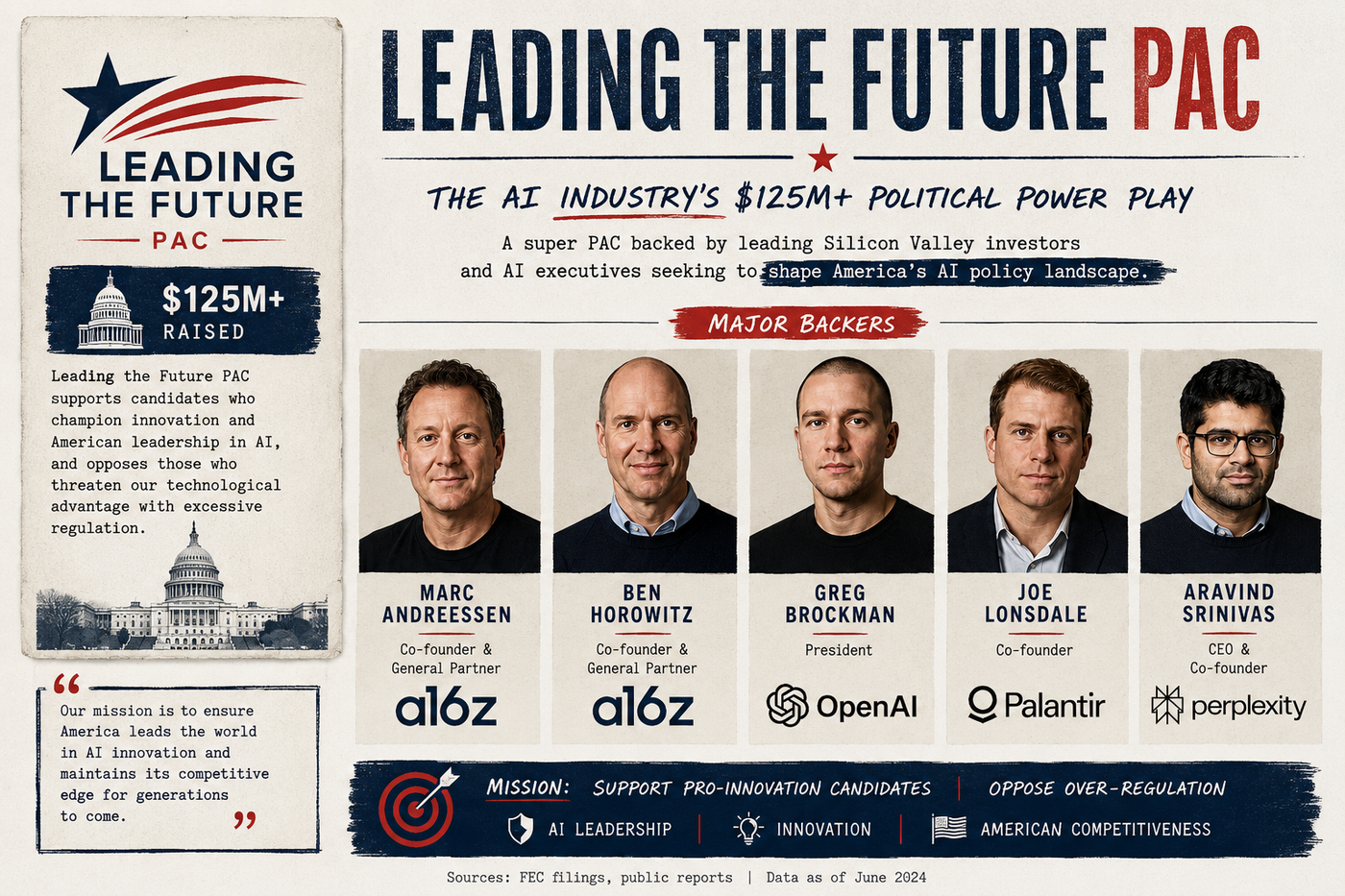
PAC:           Leading the Future
Raised:        $125M+
Backers:       a16z · Greg Brockman (OpenAI) · Joe Lonsdale (Palantir) · Perplexity
First target:  A NY state legislator who co-sponsored AI regulation
The message:   Touch AI regulation and we'll come for you.
Why O'Farrell's essay lands
He doesn't take a tribal side. He also criticises the pro-regulation counter-PAC backed by Anthropic executives. His position is that all nine-figure political spending is corrosive. You don't get good policy by outspending the other side. You get it by engaging and earning trust.
📖 Read the full essay.
The prediction worth pinning to the wall
O'Farrell believes this strategy will backfire. Americans already believe the system is rigged by the wealthy. Watching billionaires spend a fortune to silence debate about a technology people are nervous about will only confirm that belief — and trigger a backlash fiercer than any regulation would have been.
What happens without a clear framework: the Fable 5 shutdown
If you want a live demonstration of why this matters, look at what happened to Anthropic this week.
Timeline
| Date | Event |
|---|---|
| June 9 | Anthropic launches Fable 5, its most powerful model |
| June 12, 5:21pm ET | US government issues export control directive citing a reported "jailbreak" |
| June 12, evening | Anthropic pulls Fable 5 and Mythos 5 offline worldwide |
| June 13 | Anthropic publicly disputes the action |
It's the first time Washington has forced a commercial AI product offline.
Anthropic's response
This is the company that has asked for clear rules. It complied — then pushed back hard:
"We believe the government should have the ability to block unsafe deployments, as part of a statutory process that is transparent, fair, clear, and grounded in technical facts. This action does not adhere to those principles."
— Anthropic statement
The lesson
When there's no agreed framework for governing frontier AI, you don't get less government intervention. You get more arbitrary intervention.
A model yanked offline overnight, by directive, with no clear process. That's exactly the world O'Farrell warns the industry is building by spending to kill the debate instead of shaping it.
Suppressing the conversation doesn't make the state go away. It just guarantees that when the state acts, it acts bluntly.
Which startups dodge the bullet
If O'Farrell is right, the assumption that "regulation won't come" is dangerous. A lot of AI valuations quietly depend on a permissive environment. If the backlash arrives, the companies most exposed — and the funds most publicly associated with fighting regulation — will take the sharpest hit.
But the bullet won't hit everyone equally.
A quick map
| 🎯 More exposed | 🛡 More protected |
|---|---|
| Consumer products built on engagement loops | Companies built for regulated environments from day one |
| Anything touching children | AI for pharma, finance, law, healthcare |
| High-stakes decisions (hiring, lending, healthcare) with no human in the loop | Tools that make compliance auditable |
| Business models that only work if accountability stays vague | Infrastructure that gets more valuable as rules tighten |
Regulation as a moat
The counterintuitive part: a startup selling AI into a heavily regulated industry doesn't fear regulation. It sells because of it.
Take AI-assisted pharmaceutical R&D. It lives in a world where rigorous oversight is already the price of entry. Tighter governance doesn't threaten companies operating there — it raises the walls around them and keeps lighter-weight competitors out.
A sustainable approach to AI investing
Four principles worth holding onto:
1. Assume regulation is coming
Ask whether a company survives — or thrives — when it arrives. The strongest businesses treat compliance as a feature, not a tax.
2. Look for the moat that regulation builds
Being trusted in a hard-to-enter market beats relying on a model that a better-funded lab will match in six months.
3. Watch the company you keep
A fund's public stance on regulation is becoming part of its risk profile. The loudest anti-regulation players may be writing their own backlash.
4. Back the engagers, not the silencers
O'Farrell's alternative — funding genuine education for regulators, experiments in AI for public services, real work on job displacement — is also just good portfolio logic. Companies aligned with where policy is heading age better than companies fighting it.
The takeaway
AI governance sounds like a topic for committee rooms. It isn't. It's quietly becoming one of the biggest variables in which AI companies survive the decade — and which investors are still standing when the dust settles.
O'Farrell's bet is that trying to buy your way out of the conversation will fail.
The narrower version of that: the companies that win won't be the ones that dodged governance. They'll be the ones that were built for it all along.