
Opera Introduces WebAI for Local Models
Opera begins previewing WebAI, a proposed browser API framework that lets websites and extensions use models running on users' own devices.
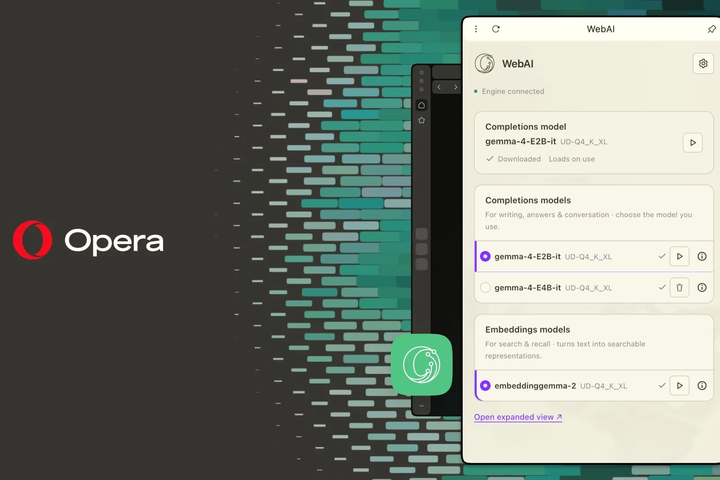
Not every AI request needs to travel to a data centre. Opera is testing a browser-based approach that lets websites and extensions use models running on a user's own computer.
What happened
Opera introduced WebAI as an early preview and proposed web standard for local AI. Its implementation lets developers call compatible models through browser APIs for tasks such as text generation, content classification and semantic matching.
The system supports selected open-weight models, including Google Gemma, and compatible on-device models available through supported operating systems. WebAI is opt-in, and websites require user permission to access the capability. Initial availability depends on compatible Windows and Apple silicon Mac hardware.
Opera also demonstrated experimental extensions built on local inference. The technology remains at an early stage, and a proposal backed by industry participants is not equivalent to universal support across browsers.
Why it matters
Cloud model APIs can create recurring charges, latency and data-handling concerns for lightweight web applications. Local inference could eliminate some per-request costs and keep the information being processed on the device.
The trade-offs are significant: model size, device memory, hardware compatibility, battery impact and inconsistent performance across users. Developers will also need clear permissions so untrusted sites cannot misuse locally available capabilities.
The bigger picture
AI is becoming part of the browser's technical infrastructure rather than only a cloud service reached through an app. If interoperable local APIs gain adoption, they could shift some AI development toward smaller models and applications that work without constant network access.